

By: The Caffeinated Gear Team
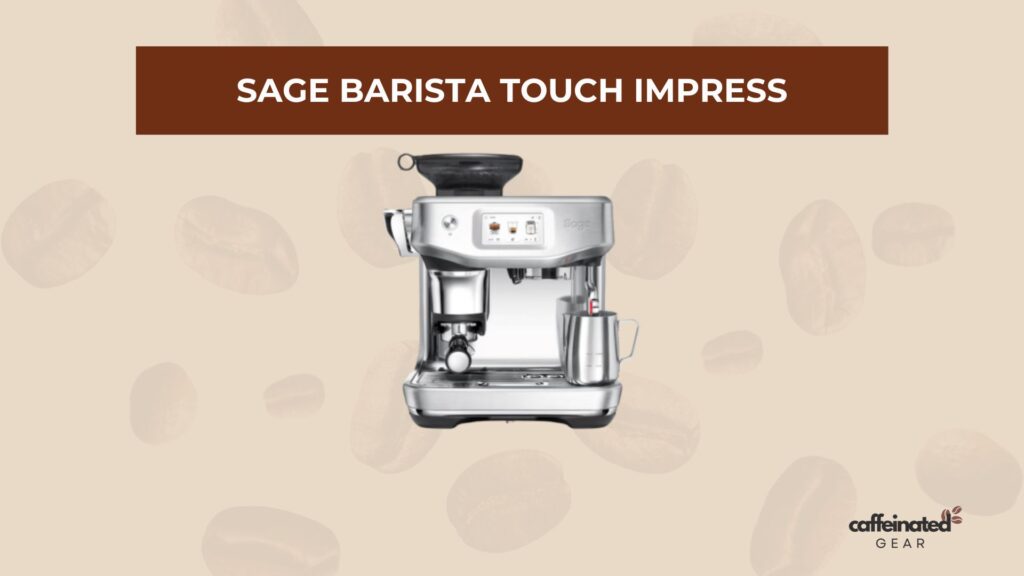
When a new espresso machine arrives at our testing lab, there’s always a buzz of excitement.
But when Sage unveiled their Barista Touch Impress, our entire team of coffee experts couldn’t wait to put it through its paces.
After spending countless hours testing every feature, pulling hundreds of shots, and pushing this machine to its limits, we’re ready to share our comprehensive findings.
This isn’t just another espresso machine review – it’s the culmination of our team’s deep expertise and hands-on experience with what could be Sage’s most innovative release yet.
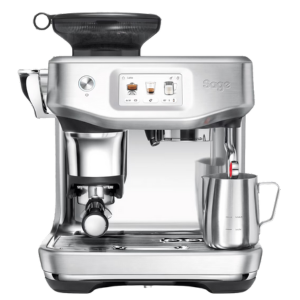
Before diving into the nitty-gritty details of our testing process, let’s address the fundamental question many coffee enthusiasts are asking: what exactly sets the Barista Touch Impress apart in Sage’s lineup of Sage coffee machines?
Understanding this machine’s unique position in the market is crucial, as it represents a significant evolution in home espresso brewing.
Our testing revealed that this isn’t a machine that sits in the middle ground – you’ll either fall in love with its innovative features or realise you need something different entirely.
Let us explain why.
After months of intensive testing, we’ve discovered something remarkable: the Sage Barista Touch Impress bridges the gap between professional espresso machines and automated coffee makers in a way we’ve never seen before.
This innovative machine delivers authentic espresso and café-quality drinks with the simplicity of a bean-to-cup system. It’s designed for coffee lovers who want exceptional espresso without spending years perfecting their barista technique.
But here’s the burning question on everyone’s mind: Can this hybrid approach really match the quality of a traditional espresso machine while offering the convenience of a bean-to-cup system?
We’ll cut straight to the chase – our testing shows that yes, it absolutely can.
The Barista Touch Impress produces genuine espresso that would satisfy even our most demanding team members. The milk texturing capabilities are particularly impressive, producing microfoam that rivals what you’d find in speciality coffee shops. When compared to standard bean-to-cup machines, it’s simply in a different league, especially regarding espresso quality and milk texture control.
Now, we’re big fans of bean-to-cup machines, particularly at the entry level. They’re brilliant for enjoying fresh-bean coffee at home, and we’d choose them over pod machines any day – not least because using fresh beans often works out more economical.
However, if budget isn’t your primary concern and you’re willing to invest in superior coffee quality, we strongly recommend considering the Barista Touch Impress before settling on a high-end bean-to-cup machine.
In our experience testing countless machines, once you move beyond the £300-£400 range towards the £1,000 mark, you’re primarily paying for additional features and improved user experience rather than significantly better coffee. The core components – grinders and brewing units – often remain surprisingly similar across price points within the same brand.
Typically, stepping up to the £1,000-£1,200 range brings fancy touchscreens and perhaps marginally better milk texturing, but the fundamental coffee quality doesn’t change dramatically. Until now, achieving notably better espresso usually meant sacrificing convenience for a traditional manual machine and developing proper barista skills.
Sage has brilliantly identified and addressed a crucial market gap: coffee enthusiasts who want both superior quality and push-button convenience.
While their Oracle Touch first tackled this challenge, its steep price tag was a significant barrier. The Touch Impress, however, comes in at roughly half the price, and based on our testing, we actually prefer its user experience to the Oracle Touch’s (though we suspect Sage might update the Oracle’s interface in future).
These specifications might seem overwhelming at first glance, but don’t worry – we’ll break down exactly what each feature means for your daily coffee routine.
Let’s walk through a typical morning scenario making a flat white, based on our daily testing experience:
You stumble to your kitchen, still bleary-eyed, and tap the machine to wake it up. By the time you’ve grabbed your milk and favourite mug, it’s ready to brew (unless you’re incredibly quick – that 3-second heat-up time is no joke).
A quick swipe of the touchscreen lets you select your drink – either the standard flat white or your custom creation if you’ve saved one. The screen guides you to insert the portafilter into the grinding cradle. One tap of the grinder icon, and it doses the perfect amount of coffee.
The tamping process is brilliantly simple – a gentle press of the lever (manageable with just a finger or two) and the machine handles the hard work. You’ll hear a satisfying beep and see a tick on the screen confirming the correct dose, which stays consistent unless you change your beans or grind setting.
Following the on-screen prompts, you’ll lock the portafilter in place, position your cup, and start the shot. Pour your preferred milk into the jug, position it with the steam wand, and place it on the drip tray’s temperature sensor. Here’s where it gets clever – you can choose whether to steam milk first then pull the shot, or vice versa, by selecting the sequence of the espresso and milk icons.
Rather than hovering over the machine, you’re free to spend those 30-40 seconds hunting down your keys or feeding the cat. The machine remembers your preferred milk type (dairy, soy, oat, or almond) from your initial setup, though you can easily change this through the milk icon menu when needed.
The final steps? Simply pour your perfectly textured milk into the espresso and knock out the used coffee puck. You’ve just crafted a café-quality flat white for roughly 40 to 90 pence, depending on your choice of beans and milk.
During our extensive testing of the Barista Touch Impress, we noticed a fascinating paradox worth addressing – particularly for those who might be comparing it to bean-to-cup machines.
Let’s cut through the marketing fog here: bean-to-cup machines aren’t always the paragons of convenience they’re made out to be.
While they’re straightforward to operate, our testing reveals they demand regular maintenance – from cleaning milk systems to emptying dreg drawers and drip trays every 5-12 drinks.
What genuinely surprised our testing team was the Barista Touch Impress’s workflow.
It’s remarkably streamlined and user-friendly, matching (and often surpassing) the convenience of many bean-to-cup machines we’ve tested.
In fact, some members of our team found it more straightforward to use than certain bean-to-cup models, which can vary significantly in their user-friendliness.
Let’s be honest – we’ve seen enough coffee machine marketing to fill a book with outlandish claims about “barista quality.”
Most of these claims are, to put it bluntly, complete rubbish.
But what exactly constitutes “barista quality”?
In our years of testing and reviewing machines (and sampling far too many disappointing flat whites), we’ve learned that even some café baristas miss the mark without proper training.
For us, true barista quality means achieving something beyond what typical bean-to-cup machines deliver – though that’s not a criticism of bean-to-cup machines, as they certainly satisfy many coffee lovers’ needs.
After thorough testing with various coffee beans, we confidently say the Barista Touch Impress matches what you’d expect from a skilled home barista using the Barista Pro – assuming they’ve properly dialled in their grind and mastered milk texturing.
Our definition of barista quality hinges on two key factors: authentic espresso extraction and precise milk texturing for each specific drink type.
When we say “authentic” espresso, we’re talking about that rich, full-bodied shot you get from a traditional portafilter machine.
It’s unmistakable once you’ve experienced it.
For those curious about what sets this apart, we recommend consulting the indy coffee guide for your area or downloading the free best coffee guide app.
Visit a speciality coffee shop and order a straight espresso (skip the sugar and milk).
Our tip: give it a quick stir first, and keep water handy if you’re new to espresso drinking.
Once you’ve experienced a properly extracted espresso shot, you’ll understand why we distinguish between “authentic” espresso and bean-to-cup machine output.
In our experience, bean-to-cup espresso shares similarities with pod machine espresso.
This isn’t about better or worse – it’s simply different.
The variables change: dose, water temperature, pressure, ratio, and ultimately, the flavour profile.
Many coffee drinkers actually prefer the mellower shots from pod or bean-to-cup machines, which partly explains their market dominance.
However, we’re noticing a shift as more people discover and develop a taste for traditional espresso.
The Barista Touch Impress delivers what we consider authentic espresso – the kind you’d expect from a traditional espresso machine.
After spending countless hours testing various coffee machines in our speciality coffee lab, we’ve discovered something rather special about the Sage Barista Touch Impress.
Let’s address something straight away: if you’re like most coffee lovers, you probably grab your morning brew from wherever’s convenient.
Perhaps you rely on instant coffee, pods, or the nearest café chain.
There’s absolutely nothing wrong with that – in fact, many members of our testing team started exactly there.
We distinctly remember those days of thinking all coffee essentially tasted the same, just with subtle variations between brands.
Sure, we could spot the difference between a Costa and a Starbucks, or between premium and standard instant coffee brands, but they all seemed perfectly acceptable.
Recently, our team conducted an interesting experiment: we revisited some of those “barista-style” instant coffees we used to enjoy.
The results were eye-opening – our trained palates could hardly believe what we once considered satisfying!
But here’s the brilliant thing about the Touch Impress: if you’re currently in that “everyday coffee drinker” category, prepare to be genuinely amazed by the quality this machine delivers.
For those already versed in home espresso making who want flexibility between automated assistance and manual control, we’d suggest checking out the Barista Express Impress.
Our team has extensively tested the Barista Express Impress, producing numerous detailed video reviews and in-depth analyses.
It’s a remarkably versatile machine that we particularly recommend for households split between coffee enthusiasts and those who prefer a simpler brewing experience.
Now, let’s explore some of the Touch Impress’s most impressive features – we won’t cover everything, as this review is already quite comprehensive, but we’ll highlight the capabilities that truly surprised us during testing.
Intelligent Drink Sequencing
One feature that particularly impressed our testing team is the intelligent drink queuing system.
The machine cleverly sequences milk steaming after espresso extraction (or vice versa, depending on your preference).
While this might seem like a small detail, the ability to automatically trigger milk steaming once your shot finishes saves valuable time in your morning routine.
Traditionally, this kind of convenience was only available with high-end dual boiler machines like the Sage Dual Boiler, Oracle, or Oracle Touch.
The Touch Impress cleverly solves this limitation without requiring dual boiler technology.
Yes, it still performs these operations sequentially, but the automated queuing system means you’re free to attend to other tasks rather than waiting to manually start the next step.
Another brilliant feature is the Americano sequencing.
You can choose whether to start with hot water or espresso, and the machine automatically follows with the other component.
If you prefer water first, your espresso will pull immediately after, while choosing espresso first triggers the hot water dispensing once the shot completes – another thoughtful time-saving innovation.
Comprehensive Drink Selection
The drinks menu covers all the essentials: espresso, Americano/long black, cappuccino, latte, flat white, milk only, babyccino, hot chocolate, and tea.
While most options are standard, there are some clever additions.
The Americano/long black customisation (water or espresso first) shows attention to detail, and extras like babyccino, hot chocolate, and tea demonstrate practical versatility.
Speaking of flat whites – this machine produces a genuine article.
Being an Australian company (known as Breville worldwide but marketed as Sage in Europe), they understand the importance of a proper flat white.
Our testing revealed that unlike many bean-to-cup machines claiming to make flat whites, the Touch Impress actually achieves the precise milk texture and intensity required for this demanding drink.
The babyccino option is both clever marketing and genuinely useful.
While you could achieve similar results using the milk-only setting with adjusted temperature and texture, having a dedicated preset makes life easier when preparing drinks for little ones.
Similarly, the hot chocolate setting offers convenient programmability for texture and temperature, plus helpful on-screen reminders about adding powder to the cup rather than the milk jug.
Now, some might wonder whether an experienced barista could achieve better results with a traditional machine compared to a novice using the Touch Impress.
In our experience, this question misses the point entirely.
It assumes both users share the same taste preferences, which isn’t typically the case.
This machine is designed for coffee enthusiasts who want exceptional drinks without becoming coffee scientists.
Based on our extensive testing, we’re confident it will exceed expectations for most users.
Even more telling: many professional baristas on our team were genuinely impressed by the quality of drinks it produces.
During our extensive testing, the Touch Impress’s grind size assistance feature stood out as particularly brilliant. As coffee professionals, we were genuinely impressed by this groundbreaking addition to home espresso making. While it might seem straightforward, this is actually the first home machine we’ve encountered that offers this crucial guidance.
The system works brilliantly for its intended purpose. Rather than promising pinpoint precision, it guides users away from the extremes of too coarse or too fine – exactly what most home baristas need to make consistently good coffee.
This feature particularly resonates with us because grind size questions dominate our inbox. When readers ask about specific grind settings, we direct them to our simplifying espresso video series. The reality is, no one can prescribe exact grind settings because they vary based on:
This assistance feature helps users find their sweet spot more easily, which we believe will significantly boost user satisfaction.
The cleverly named Auto MilQ™ system brings genuine intelligence to milk steaming. Our testing revealed its impressive versatility across four milk types: dairy, oat, soy, and almond.
What sets this system apart is its sophisticated programming. It accounts for the different stretching characteristics of each milk type, ensuring consistent results regardless of your preferred milk choice. During our trials with dairy and oat milk, the results were remarkably consistent.
After thorough testing, we found remarkably few issues – and those we did find might not concern the machine’s target user. The main limitation we noticed involves shot volume customisation. While you can adjust volumes, the increments are quite large, using either the slider or plus button.
For most users, this won’t be an issue. However, as coffee professionals, we’d appreciate:
We’ve noticed some online discussions about screen responsiveness, sparked by early review videos from the US and Australia. We can confidently say these concerns are unfounded. The apparent lag in videos stems from camera refresh rates rather than actual performance issues.
In our hands-on testing, this touch screen proved to be the most responsive we’ve encountered on any coffee machine, offering smooth, immediate feedback.
If you’re seeking café-quality drinks with an exceptional user experience, this machine deserves serious consideration. Currently, we can’t think of a better option – even the Oracle Touch, at nearly twice the price, doesn’t quite match its user-friendly approach.
When considering value, we encourage looking beyond the initial price tag. Consider:
While more affordable machines exist, none we’ve tested match the Touch Impress’s combination of drink quality and user experience at this price point.
For regular café customers, the cost savings can be substantial. Using quality beans and your chosen milk, each drink costs between 40-90 pence. Many of our readers report their machines paying for themselves within 1-2 years through saved café expenses.
We’ve received numerous queries about the Barista Touch’s future. Rest assured, it’s not being discontinued.
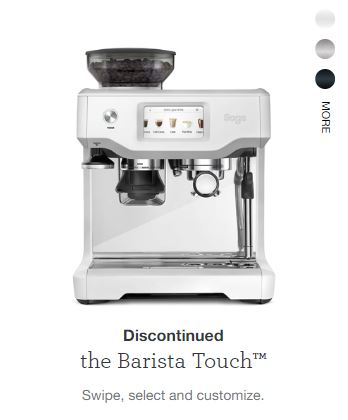
This misconception stems from a website quirk where “Discontinued” appears above certain colour variants in the parts and accessories section. As experts who closely follow the Sage coffee machines range, we can explain their product strategy:
Caffeinatedgear.com is a participant in the Amazon Services LLC Associates Program, an affiliate advertising program designed to provide a means for sites to earn advertising fees by advertising and linking to amazon.co.uk.
© 2025 Caffeinated Gear.