

By: The Caffeinated Gear Team

After spending countless hours pulling shots and serving thousands of espressos, we’re sharing our comprehensive review of the original Gaggia Classic espresso machine – specifically the pre-2009 model that started many of us on our coffee journey.
In our years of testing and using various espresso machines, this particular model stands out for reasons we’ll explore in detail.
Let’s start with some crucial background about this iconic machine.
The story begins in 1991 when Gaggia launched what would become their most celebrated home espresso machine. Within just a few years, it established itself as one of the most popular home espresso machines, particularly among those serious about crafting quality espresso at home.
Our research shows that an impressive number of today’s passionate home baristas began their coffee-making journey with this particular model.
Through our hands-on experience, we can confirm that the original Gaggia Classic was built like a fortress. Instead of complicated electronics and fancy features, it relied on solid engineering principles and quality components.
Key features that impressed us include:
What particularly caught our attention was how easily you could modify the steam wand. Swapping out the standard Panarello for a Rancilio Silvia steam wand cost about £15 and dramatically improved milk frothing capability.
One aspect we truly appreciate is its repair-friendly design. With readily available parts even today, these machines are incredibly sustainable. The unit we’ve been testing since 2003 continues to perform brilliantly despite heavy daily use and basic maintenance.
The 2015 Gaggia Classic Model.
The machine’s story took a significant turn in 2009. While Saeco International’s 1999 acquisition of Gaggia hadn’t disrupted the Classic’s successful formula, Phillips’ takeover of Saeco in 2009 brought substantial changes.
Manufacturing moved away from Italy, and perhaps most controversially, they removed the traditional 3-way solenoid valve. Based on our testing experience and wider community feedback, these changes marked the end of an era for the Classic’s original charm.
A silver lining emerged when Gaggia UK’s leadership established Gaggia Direct (Caffe Shop Ltd), ensuring continued distribution of Gaggia products in the UK.
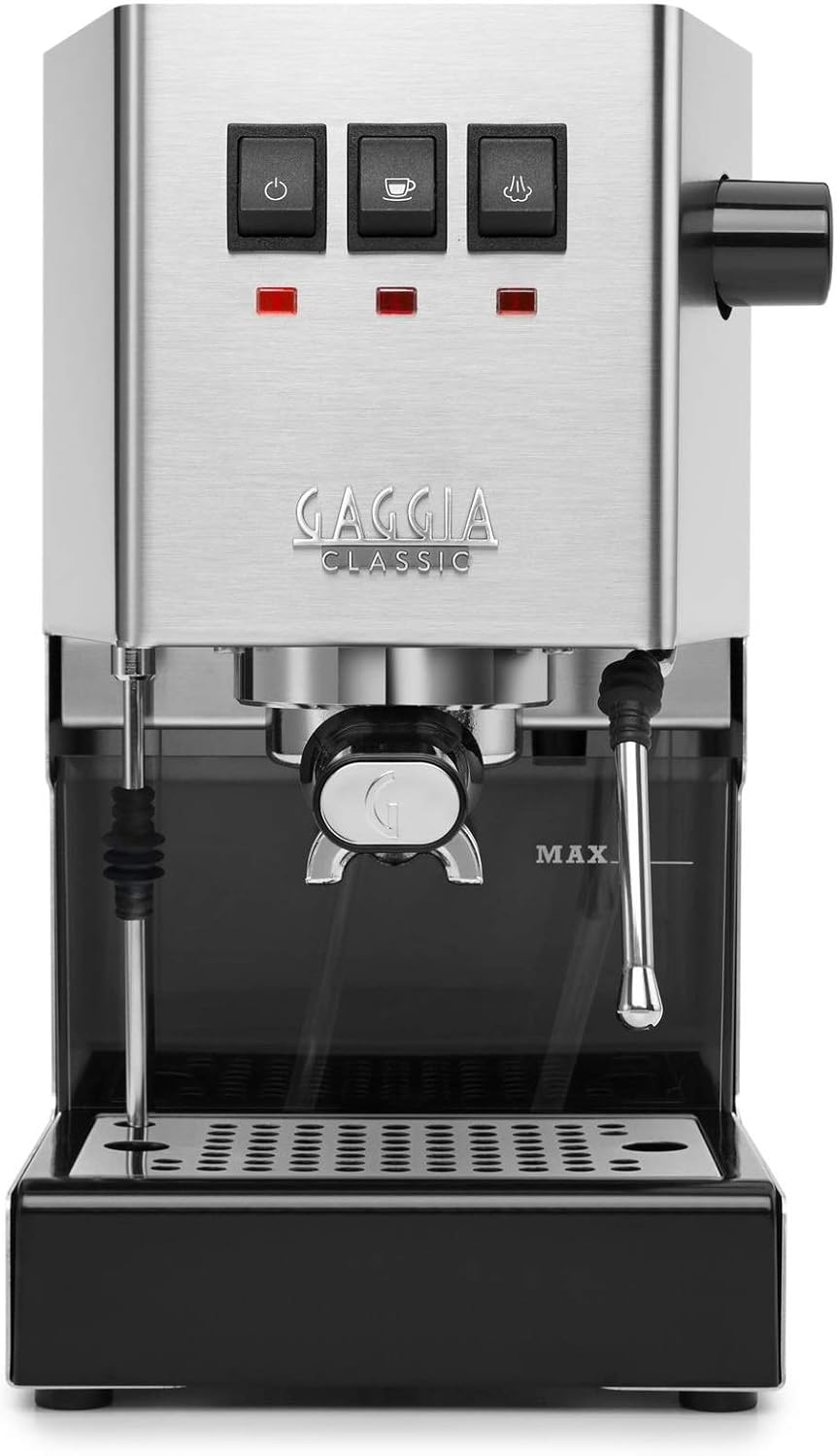
Buyer Beware: Our team has spotted several retailers offering the Gaggia Classic Pro at suspiciously low prices, typically between £315-£330.
While these deals might seem tempting, we’ve discovered that many of these supposedly UK-based websites are actually selling grey imports.
What does this mean for you?
These machines typically arrive without a UK warranty, take over a week for delivery, and might not meet UK specifications.
We strongly recommend purchasing from Gaggia Direct, the official UK distributor for Gaggia Milano.
Here’s why:
As coffee enthusiasts and professional baristas, we were thrilled when we first heard whispers about Gaggia’s plans to revamp the Classic.
The rumours suggested something remarkable: a return to the original Classic’s beloved design principles.
Initially, we were sceptical.
After all, the 2015 model had moved significantly away from the original Classic’s design (including a rather frustrating steam wand that resisted modification).
But Gaggia surprised us all.
The new Gaggia Classic Pro (also known as the Gaggia Classic 2019) brings back everything we loved about the original, with some brilliant improvements:
This upgrade particularly caught our attention.
For years, our team had wondered why Gaggia hadn’t addressed the common practice of steam wand modification among their customers.
Now they’ve finally done it, incorporating a professional-grade steam wand with a 2-hole tip straight from the factory.
There’s just one small difference between the Pro version and its predecessor: the OPV (over pressure valve) comes fixed at approximately 14 bars of pressure.
However, don’t let this put you off.
For those who prefer the traditional 9 bars of pressure, there’s a straightforward solution: a simple £10 OPV spring modification gets the job done perfectly.
Our team has performed this modification countless times – it’s quick, simple, and makes a noticeable difference to your espresso extraction.
After months of hands-on testing, we’ve discovered something interesting about the pre-2009 Gaggia Classic models that might surprise you.
Price used to be the main deciding factor, but the market has shifted dramatically in recent years.
Our research shows that pre-2009 Gaggia Classics now command prices between £200-£300 on the secondary market.
Interestingly, the 2015 model can be found for significantly less – around £80-£90. While it shares the Classic’s appearance, we’d say it’s more comparable to the Gaggia Coffee in terms of capabilities.
For casual coffee drinkers seeking an affordable espresso machine, the 2015 model at those prices offers remarkable value compared to new machines in the same price bracket.
However, for aspiring home baristas wanting more control and capability, it’s worth noting that the new Classic Pro typically sells for under £400.
Our personal experience with the original Classic stems from purchasing one several years ago for £100 when prices were much lower.
Given today’s market, we’d hesitate to spend £300 on a 12-20 year old machine when Gaggia Direct offers the new model with a 3-year warranty for just £100 more.
We’d only recommend buying an original Classic now if you find it at a significant discount.
Despite their legendary build quality and resistance to rust, we suggest paying no more than 50% of a new model’s price for a pre-2009 machine.
Stay tuned for our tips on buying original Classics on eBay later in this article.
Now, let’s dive into our comprehensive review of the original Classic, which we’ve continuously updated since 2016.
This review, initially written in March 2016, has been regularly updated to reflect our ongoing experience with the machine.
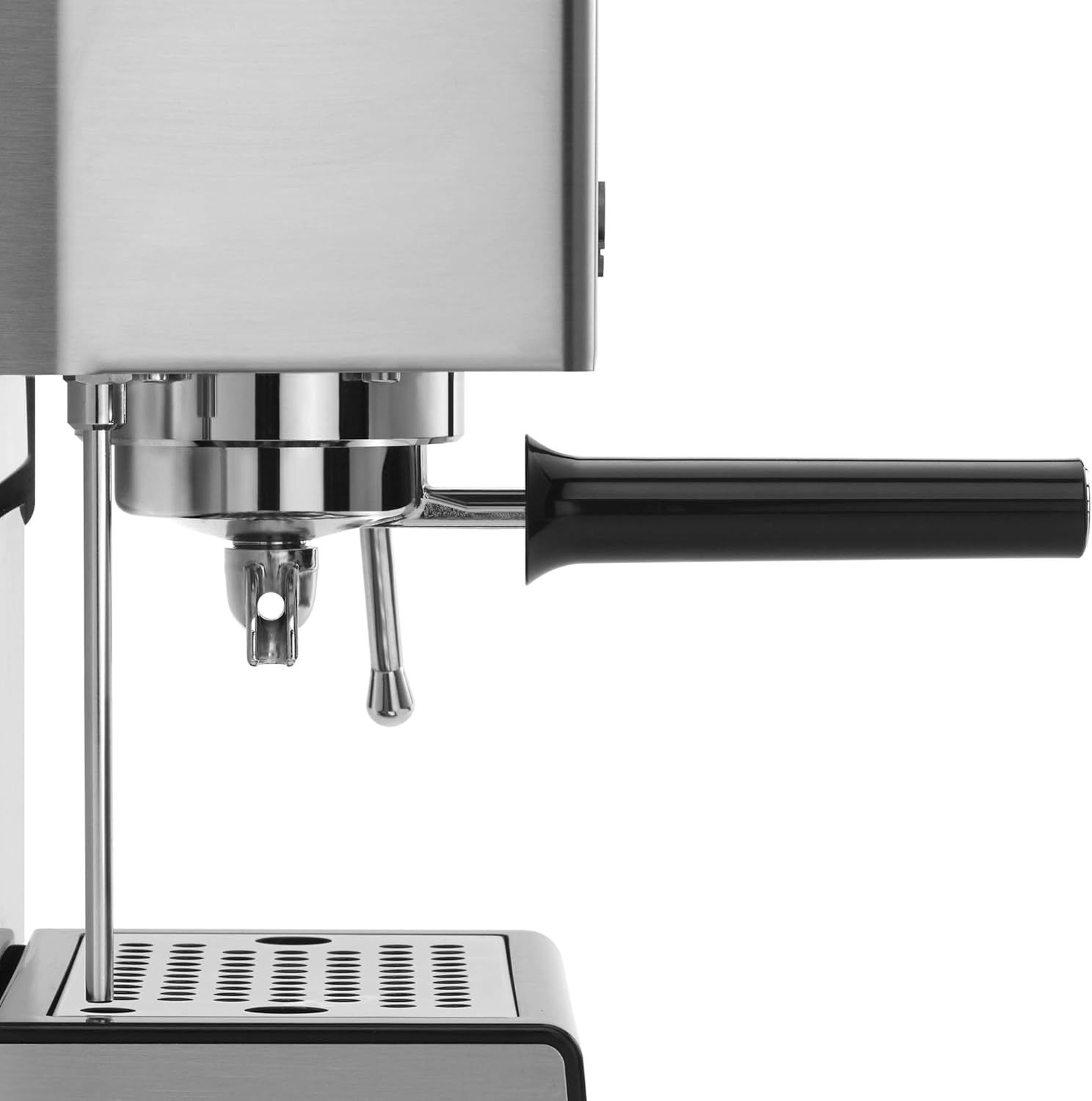
Our test model from 2003.
For those venturing into home espresso making, particularly if you’re aiming to develop genuine home Barista skills rather than relying on automatic buttons, the pre-2009 Gaggia Classic deserves serious consideration.
Our initial research in 2016 highlighted the original Classic (pre-2009) as an excellent starting point. While they were more affordable then, today’s market values them at around £300 – just £100 less than the new Gaggia Classic Pro.
We acquired our 2003 model for £100 when prices were lower. Despite initial reservations about its age, extensive research into their durability and maintainability convinced us to proceed.
Here’s a fascinating bit of coffee history: Gaggia actually invented modern espresso as we know it.
While France produced the first espresso machine in the early 1800s, and Italian food chemist Ernesto Illy created the first automatic version, modern espresso emerged from a Milan café owner named Achille Gaggia.
His groundbreaking patent #365726 for a “steam-free coffee machine” (filed 5th September 1938) revolutionised espresso making with a novel piston mechanism – reportedly inspired by a US Army Jeep’s hydraulic system.
Coming back to the Classic – it’s a single boiler machine that’s earned its reputation as one of the finest entry-level semi-automatic espresso makers.
Historically, only the Rancilio Silvia rivalled it in this category, offering slightly better performance but perhaps less user-friendly features.
While the Silvia came with a professional steam wand as standard, upgrading the Classic with a Rancilio wand takes just 10 minutes and costs about £15.
We’ve noticed some critics of the Classic often haven’t used one extensively or compare it to machines costing substantially more. Those with hands-on experience typically praise its capabilities.
Despite its modest appearance and standard steam wand, we firmly classify the Classic (pre-2009 and Pro models) as a proper home barista espresso machine.
While it might lack premium features like PID temperature control or an E61 group head, it boasts:
A commercial-grade 58mm portafilter crafted from chrome-plated brass.
The pre-2009 models (and current Pro) feature a 3-way solenoid valve – rare in domestic machines.
Its vibration pump matches those found in pricier espresso machines.
Its widespread adoption by home baristas confirms its status as more than just another domestic appliance.
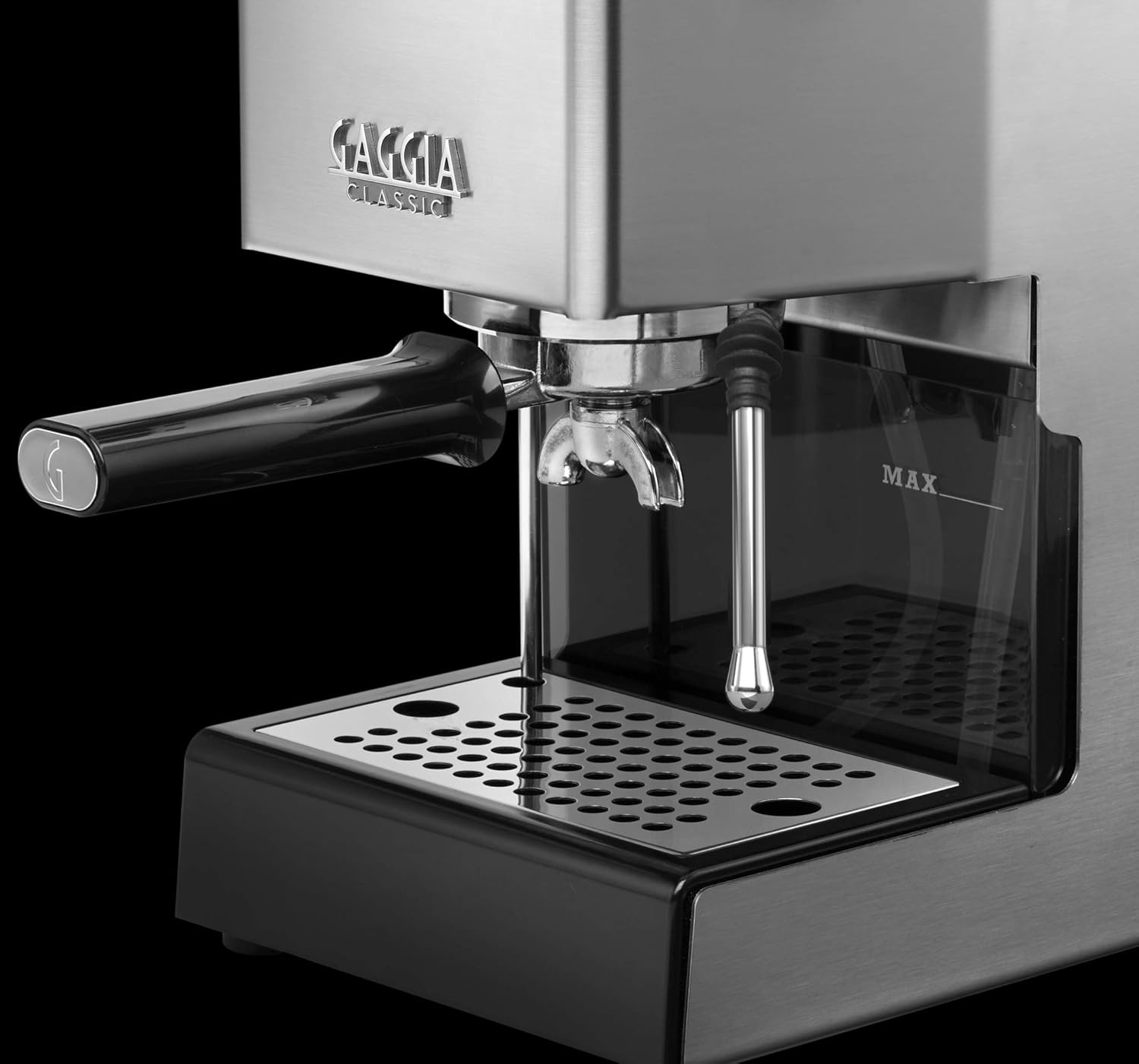
The results have impressed us thoroughly! The espresso quality exceeds expectations, and after the steam wand modification, the milk texturing capabilities are remarkable.
We’re achieving consistently good espresso shots (with occasional learning curves).
Steam power impresses despite the compact boiler size. We’ve developed an efficient workflow: turning off steam and purging for 30 seconds returns the boiler to espresso temperature quickly for multiple drinks.
For our investment, this machine offers exceptional value and serves as an ideal platform for developing barista skills.
The results have impressed us thoroughly! The espresso quality exceeds expectations, and after the steam wand modification, the milk texturing capabilities are remarkable.
We’re achieving consistently good espresso shots (with occasional learning curves).
Steam power impresses despite the compact boiler size. We’ve developed an efficient workflow: turning off steam and purging for 30 seconds returns the boiler to espresso temperature quickly for multiple drinks.
For our investment, this machine offers exceptional value and serves as an ideal platform for developing barista skills.
Compact Design: Perfect for smaller kitchens without compromising capabilities.
Understated Aesthetics: Clean, professional appearance that suits any kitchen style.
Efficient Heat-Up: Ready for action in roughly 5 minutes, despite some recommendations for longer warm-up times.
Excellent Espresso Quality: While coffee quality, grinder selection, and technique matter greatly, this machine consistently enables high-quality shots.
Generous Water Capacity: The 2.1-litre tank doubles most competitors’ capacity in this price range.
Proven Longevity: With proper care, these machines often serve for decades. Many 15-20 year old units still perform perfectly on the second-hand market.
Repairability: After extensive testing, we’re impressed by how straightforward maintenance is on this machine. Spare parts are readily available, and most repairs can be handled without specialist knowledge.
Upgradability: One brilliant aspect of the Classic is its modification potential. While the stock Panarello wand works fine, switching to a Rancilio Silvia commercial steam wand (available for under £15) transforms the milk steaming capabilities entirely.
The stock setup can still produce decent microfoam by removing the Panarello outer sleeve and using the internal pipe, but upgrading to the Silvia wand opens up a world of professional-level milk texturing.
For temperature control enthusiasts, installing a PID kit addresses the machine’s main weakness – temperature stability. This digital enhancement gives you precise control over brewing temperature.
Steam Wand Limitations: The standard Panarello attachment produces thick, dense foam suited to traditional cappuccinos. For modern speciality coffee drinks requiring silky microfoam, you’ll need to either remove the outer sleeve or upgrade to a professional wand.
While using the internal pipe works reasonably well, we found the setup slightly awkward. Installing a proper commercial steam wand makes a noticeable difference in milk texturing quality.
Shot Consistency: During our testing, we experienced varying results – from absolutely stunning shots to some that missed the mark. This inconsistency stems from the Classic’s temperature fluctuations, a characteristic it shares with the Rancilio Silvia.
Many users master ‘temperature surfing’ to achieve optimal brewing temperature. However, installing a PID offers a more precise solution for consistently excellent shots.
Quality beans are absolutely crucial – even the finest espresso machine can’t compensate for stale coffee.
If you’re using coffee from a supermarket, with lengthy shelf lives and uncertain roasting dates, you’re missing out on the Classic’s true potential.
Our testing confirms that your grinder choice matters just as much as the espresso machine. The Classic shows its true capabilities when paired with a quality grinder.
The Sage Dose control pro offers good value for beginners. We’ve extensively tested the Sage Smart Grinder Pro and found it impressively versatile.
For dedicated espresso brewing, we’d suggest considering a worm drive grinder for finer adjustments. However, the Smart Grinder Pro proves excellent for all-round use, handling various brewing methods admirably at its price point.
For additional options, check out our comprehensive guide:
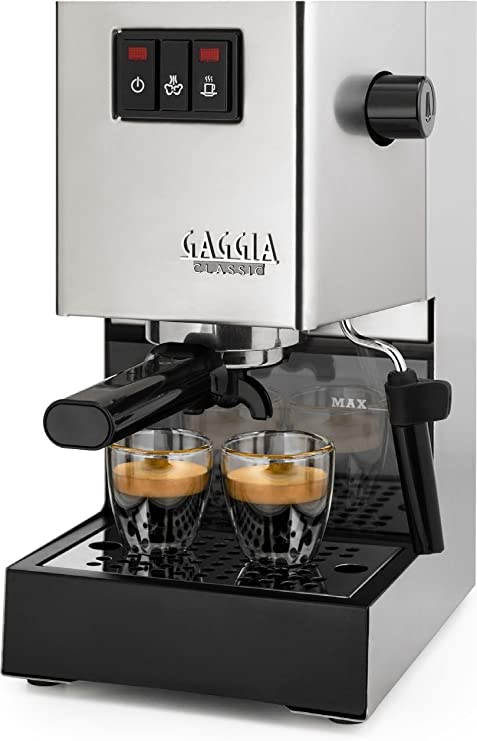
Our latte art skills keep improving with practice!
After several weeks of daily use, our appreciation for the Classic’s value proposition remains strong. We’ve noticed some minor quirks worth mentioning.
The steam wand occasionally releases a small drip – nothing significant, but worth noting.
While the ready light illuminates after 5 minutes, we’ve found the machine needs longer for optimal performance. Pulling shots this early results in slightly cooler brew temperatures and longer extraction times.
We recommend a 10-minute warm-up minimum, with 20-30 minutes being ideal when time permits.
Temperature management improves with brief steam purging before shots, though without a PID, precise temperature control remains challenging.
The photo above showcases a flat white crafted on our £100 Classic. While our latte art still needs practice, the milk texture quality demonstrates the machine’s capabilities.
The Classic continues to impress with its reliability. We regularly pull multiple shots in succession while testing and practicing latte art, pushing the machine’s capabilities.
Milk texturing consistency remains our biggest challenge, though we attribute this more to technique than machine limitations.
Pre-heating the group head and portafilter by running water through them proves essential for optimal performance, particularly when the ready light first illuminates.
Our long-term testing revealed an interesting discovery about steam power optimisation.
The compact boiler’s steam capacity depletes quickly. Rather than waiting for the steam light, we achieve better results by starting when steam first appears (typically 10-20 seconds after activation).
This technique harnesses maximum steam power. For detailed instructions, see our Gaggia Classic Latte Art Hack.
Paired with the Sage Smart grinder pro, the Classic has handled thousands of shots admirably.
After intensive use (often pushing beyond typical domestic demands), some maintenance needs emerged. We noticed steam valve leakage and occasional shot quality inconsistencies.
Our original Classic has returned to peak performance.
As mentioned in our Gaggia Classic Pro review, professional servicing restored the machine completely.
The repairs included a new steam valve (damaged from over-tightening), seal replacement, and thermostat update. This maintenance breathed new life into the machine, highlighting its exceptional longevity potential.
Few domestic machines in this price range offer such repairability and potential lifespan.
We currently alternate between the Classic and a La Pavoni Europiccola, each offering distinct brewing experiences given the Europiccola’s manual lever design.
The simplest identification method is checking the logo arrangement – original models display “Classic” above “Gaggia.”
Check the rear panel for manufacturing date stamps if photos are available. Don’t hesitate to request this information from sellers.
While portafilters include date stamps, these might not match the machine if replaced, so focus on the main unit’s dating.
Avoid emotional bidding wars. We recommend using GoofBid for strategic auction participation.
This tool allows last-second bidding and group bid management. When targeting multiple listings, it automatically withdraws other bids once you secure a machine.
Even without sniping tools, set your maximum bid and resist increasing it. Patient shopping typically yields better value.
Machine longevity often correlates with water hardness exposure. We strongly recommend targeting sellers in soft water regions.
Consult this hard water map to identify preferable locations.
Browse current Gaggia Classic listings and cross-reference locations. We suggest avoiding hard water areas unless the seller confirms exclusive use of filtered or bottled water.
Always verify the machine’s usage history regarding water hardness exposure.
Our team has carefully tracked the Gaggia Classic’s market performance over several years, with particularly interesting developments recently.
The original Gaggia Classic has become quite the collector’s item in the espresso machine market.
This surge in popularity likely stems from two key factors: the lukewarm reception of the 2015 model and the remarkable success of the newer Gaggia Classic Pro.
Through our market analysis, we’ve noticed a fascinating trend – the older model’s resale value began climbing well before recent global events affected the home coffee market.
While the home espresso sector has certainly grown, the increased demand for original Classics seems more closely tied to the positioning and success of the new Classic Pro.
However, our expert assessment suggests that current used market prices should make buyers think twice.
For roughly £100 more than many second-hand models, you can purchase a new machine from Gaggia Direct, the original Gaggia UK team from pre-Philips days.
At present, they’re even offering an extended warranty period at no extra cost.
Unless you find an exceptional deal on a well-maintained original Classic, our team strongly recommends considering the new model with its full warranty coverage.
For a detailed analysis of the latest model, check out our comprehensive
Caffeinatedgear.com is a participant in the Amazon Services LLC Associates Program, an affiliate advertising program designed to provide a means for sites to earn advertising fees by advertising and linking to amazon.co.uk.
© 2025 Caffeinated Gear.