

The Caffeinated Gear Team
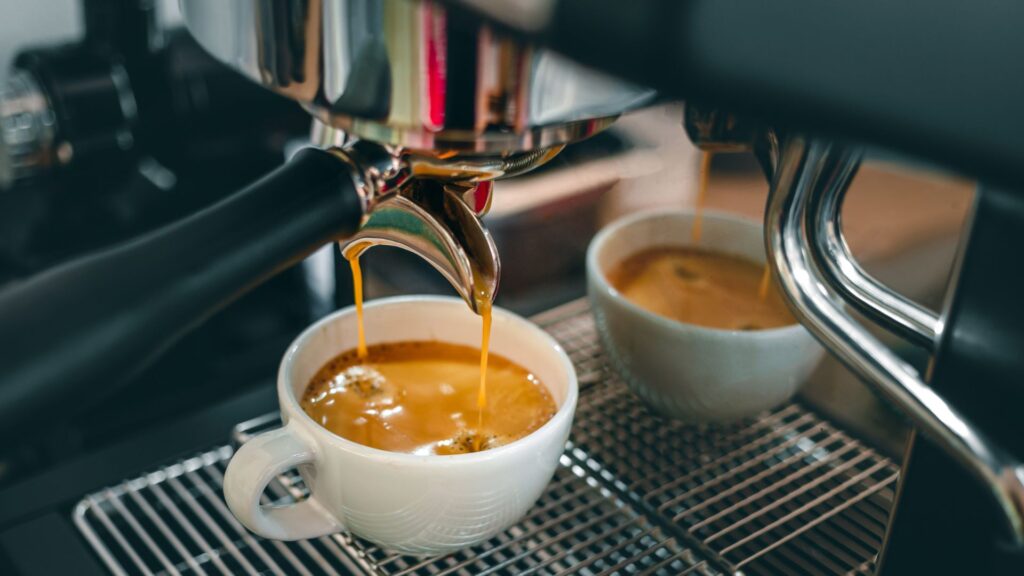
Comparing lungo vs espresso often creates confusion among coffee enthusiasts – and with good reason.
Here’s the fascinating truth: they’re technically the same thing, yet distinctly different in practice.
Intriguing, isn’t it? Let’s break down this apparent paradox.
The key lies in understanding that lungo is simply a specific style of espresso, defined by its extraction ratio.
Here’s our comprehensive guide that will clear up any confusion and help you perfect your coffee game.

At its core, espresso represents the pinnacle of concentrated coffee brewing.
Our team of certified baristas uses these precise steps to craft the perfect espresso:
First, we carefully dose freshly ground coffee into a filter basket within the portafilter.
Next, we apply consistent pressure during tamping to create an even coffee bed.
The portafilter locks securely into the machine’s group head, where pressurised water meets the coffee.
Finally, the result is a concentrated shot of pure coffee excellence.
In the world of espresso brewing, lungo stands as one of three primary extraction ratios.
Think of these ratios as a spectrum of coffee intensity, where each style brings its own character to your cup:
The ristretto (typically 1:1 ratio) represents the most concentrated form – imagine 18g of coffee yielding 18g of liquid espresso.
A normale or standard espresso (usually 1:2) doubles the yield – 18g of coffee producing 36g of espresso.
The lungo (commonly 1:3) extends further – 18g of coffee creating 54g of espresso.
For those curious about cafe crema, it pushes even further with a 1:6 ratio, though it uses a coarser grind for faster extraction.
These ratios might vary slightly – a ristretto could range from 1:1 to 1:1.5, while a normale might stretch from 1:2 to 1:2.5.

When we compare lungo with standard espresso (normale), we’re exploring subtle but significant flavour variations.
Through extensive testing, our team has found that lungo typically draws more bitter compounds from the coffee beans.
However, this doesn’t automatically make lungo inferior – it’s all about matching the ratio to your beans.
Many coffee enthusiasts overlook ratio adjustments during the dialling-in process.
We’ve seen countless cases where hours were spent adjusting grind size when a simple ratio change would have solved the issue.
If your normale tastes notably sour, try extending to a lungo – perhaps 7g coffee to 20g espresso, or 17g to 50g for a larger dose.
Not quite – this is a common misconception we often clarify during our coffee workshops.
A double shot (doppio) means doubling both the coffee dose and the yield.
Take our experience with Breville 54mm machines like the Barista Express or Bambino Plus – a single shot uses roughly 9g of coffee, while a double requires 18g.
The key distinction: double shots reference dose size, not ratio.

This comparison highlights another crucial distinction we frequently discuss with coffee enthusiasts.
While an Americano combines espresso with hot water, a lungo is pure espresso – just extracted with a higher ratio.
Though a small Americano might taste similar to a lungo, the extraction dynamics differ significantly.
Let’s clear up another common confusion – the long black.
While similar to an Americano, it typically offers a more robust flavour profile and follows a specific preparation method.
The distinction lies in both the ratio and the order of combination – we pull the espresso directly into hot water, not vice versa.
Some confusion stems from certain machines translating “lungo” as “long coffee”, but these are distinct beverages.
Based on our extensive testing, lungo can work brilliantly in milk-based drinks.
Many assume a lungo would create a weaker latte or cappuccino, but we’ve found the opposite can be true.
With certain coffee beans, the lungo’s fuller extraction can actually produce stronger flavours that shine through milk more effectively.
Through our research and testing, we’ve confirmed that caffeine content varies with ratio.
Caffeine extraction accelerates throughout the shot, meaning larger ratios generally yield more caffeine.
Given identical coffee beans and conditions, the caffeine content typically increases from ristretto to normale to lungo.
Nespresso’s system presents its own unique approach to these coffee styles.
Their Original Line offers:
While you can adjust these volumes, comparing Nespresso to traditional espresso proves challenging due to fundamental differences in extraction methods.
“Stronger” can mean different things in coffee terms, so let’s break it down:
Regarding caffeine content, a lungo typically contains more than a normale espresso (using identical beans and parameters).
For taste intensity, lungo often presents more bitter notes, which many interpret as “stronger”.
Our barista team encourages experimentation – there’s no strict rule against adding milk to lungo.
Adding steamed milk technically creates an espresso macchiato, though traditionalists might debate this classification.
We believe home brewing should prioritise personal taste over strict definitions.
The science behind lungo’s increased bitterness lies in its extended extraction.
We often demonstrate this through “salami shots” – splitting an espresso into sequential tasting portions.
This reveals how different compounds extract at different stages:
A lungo naturally includes more of these later, bitter compounds.
For optimal results, consider these factors:
The beauty of home espresso lies in finding your perfect balance through experimentation.
Caffeinatedgear.com is a participant in the Amazon Services LLC Associates Program, an affiliate advertising program designed to provide a means for sites to earn advertising fees by advertising and linking to amazon.co.uk.
© 2025 Caffeinated Gear.