

By: The Caffeinated Gear Team
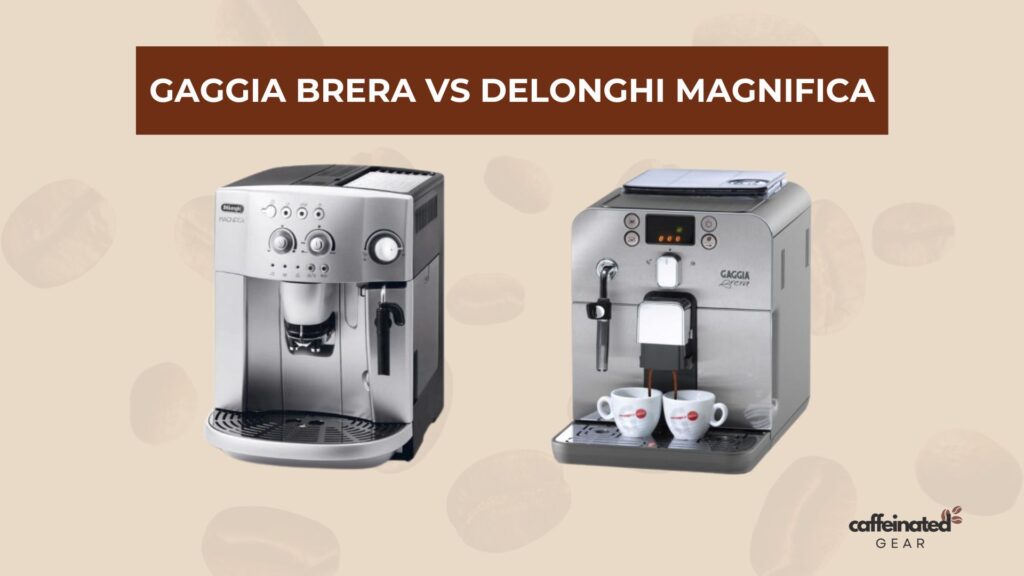
After extensive hands-on testing of both machines in our coffee lab, we’re excited to share our detailed comparison of the Gaggia Brera and DeLonghi Magnifica ESAM 4200. These popular bean-to-cup machines represent excellent value in the automatic coffee maker market, and we’ve put them through their paces to help you make the right choice.
Let’s be crystal clear – we’re focusing specifically on comparing the Gaggia Brera with the DeLonghi Magnifica ESAM 4200 model. For in-depth information about each machine individually, check out our comprehensive reviews:
As certified baristas and coffee equipment specialists, we’ve found these two machines are natural competitors. The ESAM 4200 stands as DeLonghi’s bestselling bean-to-cup machine, matching the Brera closely in both price point and functionality.
Worth noting – if you’re considering other Magnifica models, such as the ESAM 3000 or 4000 series, you’ll find this comparison helpful as they share many core features with the 4200.
For a broader look at each brand’s full range, explore our detailed brand guides:
Quick note on comparisons: If you’re looking at premium one-touch machines like the De’Longhi Eletta ECAM 44.660, we’d recommend comparing those with Gaggia’s equivalent models such as the Anima Prestige or Accademia instead. These machines compete in a different class altogether.
For more insight into Gaggia’s complete lineup, see our comprehensive guide:
After thorough measurements in our test kitchen, we’ve found some crucial differences between these machines.
The Gaggia Brera comes in at 33cm tall, 25.5cm wide, and 42.5cm deep.
In comparison, the Magnifica ESAM 4200 stands slightly taller at just under 36cm, measures 28cm in width, and has a depth of 38cm—making it 4.5cm shallower than the Brera.
One practical consideration we discovered during testing is the bean hopper access.
The Brera features a fully removable lid, while the Magnifica uses a hinged design that requires roughly 10cm of additional clearance space.
From our extensive kitchen testing, we’ve found that the Brera works brilliantly if you’re dealing with limited vertical space under cabinets.
However, if your worktop depth is at a premium, the Magnifica might be your better choice, as it needs less depth despite taking up slightly more horizontal space.
Through our own experience in various kitchen setups, the Brera proved more accommodating in kitchens with tight horizontal and vertical constraints.
During our side-by-side assessment, we noticed distinct differences in materials and design philosophy.
The DeLonghi ESAM 4200 showcases a black and silver plastic construction, while the Gaggia Brera combines genuine stainless steel with stainless steel effect plastic.
We particularly appreciate the Brera’s premium touches, like its low-profile stainless steel drip tray, which contrasts with the ESAM’s plastic tray cover.
The Brera sports a cleaner interface with fewer controls and an LED display, creating a more streamlined appearance compared to the ESAM’s button-rich facade.
While both machines would look smart in any kitchen, our team’s consensus favours the Brera’s more refined aesthetic, though we acknowledge this comes down to personal preference.
Our testing revealed notable differences in grinding capabilities between these machines.
The Brera offers 5 distinct grind settings, while the Magnifica ESAM 4200 provides 7 settings with half-step increments, offering more precise control over your grind size.
In our analysis of the burr materials, we found that Gaggia exclusively uses ceramic burrs across their bean-to-cup range, contrasting with the Magnifica’s stainless steel burrs.
Gaggia’s choice of ceramic stems from its heat-resistant properties, though in our extensive testing, we’ve found the impact on flavour to be subtle at most—it’s worth noting that most commercial grinders opt for steel burrs.
Through our hands-on experience, we’ve identified key advantages of both materials.
Steel burrs typically begin sharper but gradually dull, while ceramic burrs maintain consistent sharpness throughout their lifetime.
We value ceramic’s longevity, but our testing highlighted their vulnerability—a stray pebble could cause significant damage compared to more resilient steel burrs.
When it comes to adjusting the grind, we found the Brera’s mechanism slightly more resistant, though not problematically so, while the Magnifica offered smoother adjustment during our tests.
In our acoustic testing, we paid close attention to grinding noise levels, typically the loudest aspect of any bean-to-cup machine.
Both machines perform admirably in this department, though our measurements showed the Brera holding a slight edge in quietness.
We attribute this primarily to the Brera’s thoughtful design feature: a rubber-sealed bean hopper that not only preserves bean freshness but also provides additional sound dampening.
During our extensive testing at Caffeinated Gear, both machines impressed us with their thermoblock boiler systems. There’s that characteristic “knock, knock, knock” sound during milk steaming – a common trait that our team has come to expect from these units.
After thorough testing with various coffee beans, we achieved satisfying results from both machines. While we used different beans across our testing period, both machines demonstrated solid espresso-making capabilities. With a bit of patience during the dialling-in process, we consistently produced shots with lovely crema layers.
Here’s where things get interesting. Both machines showcase impressively quick steam readiness – a feature our baristas particularly appreciated. The steam power proved more than adequate, and once we removed the Panarello attachments (a straightforward slide-off process on both models), the milk texturing capabilities really shone through.
It’s worth noting that virtually all genuine bean-to-cup machines come equipped with Panarello wands. The good news? They’re typically simple to remove, leaving you with a single-hole steam tip for more precise control.
(A quick side note from our testing team: While machines like the Sage coffee machine series feature professional steam wands, these are technically semi-automatic espresso machines with built-in grinders, rather than true bean-to-cup systems).
The Panarello wand offers a straightforward approach to milk frothing.
Simply insert the wand into your milk, and the steam flows through a dedicated opening on the side.
This design makes it particularly accessible for beginners, requiring minimal practice to achieve results.
However, be aware that Panarello wands typically create quite thick, spoonable foam.
For those seeking silky, velvety microfoam perfect for latte art, we recommend removing the Panarello attachment.
During our extensive testing of these bean to cup coffee machines, we found both models straightforward to operate, though the Gaggia Brera stands out for its intuitive strength and volume controls.
The ESAM 4200’s volume and strength settings rely on unmarked dials, with only minimum, maximum, and a single 12 o’clock position indicator.
This design choice by De’Longhi puzzled our testing team – especially regarding the strength dial, where numerical markers would help users understand their selected coffee dose in grams.
The Gaggia Brera, by comparison, offers crystal-clear operation.
A simple press of the bean strength button cycles through three precise settings: 1 (7g), 2 (9g), and 3 (11g).
Volume adjustment is equally straightforward – just press and hold either the espresso or lungo button.
For double shots, press your chosen button twice.
For instance, to craft our preferred 18g double shot, we set strength to 2 (9g) and press the espresso button twice after setting the desired single shot volume.
The ESAM 4200’s lack of precise measurements means users must rely on trial and error for both volume and dosage.
Once you’ve found your preferred settings, you might want to add your own markers, since the unmarked dial provides no reference points.
Caffeinatedgear.com is a participant in the Amazon Services LLC Associates Program, an affiliate advertising program designed to provide a means for sites to earn advertising fees by advertising and linking to amazon.co.uk.
© 2025 Caffeinated Gear.