

By: Caffeinated Gear Review Team
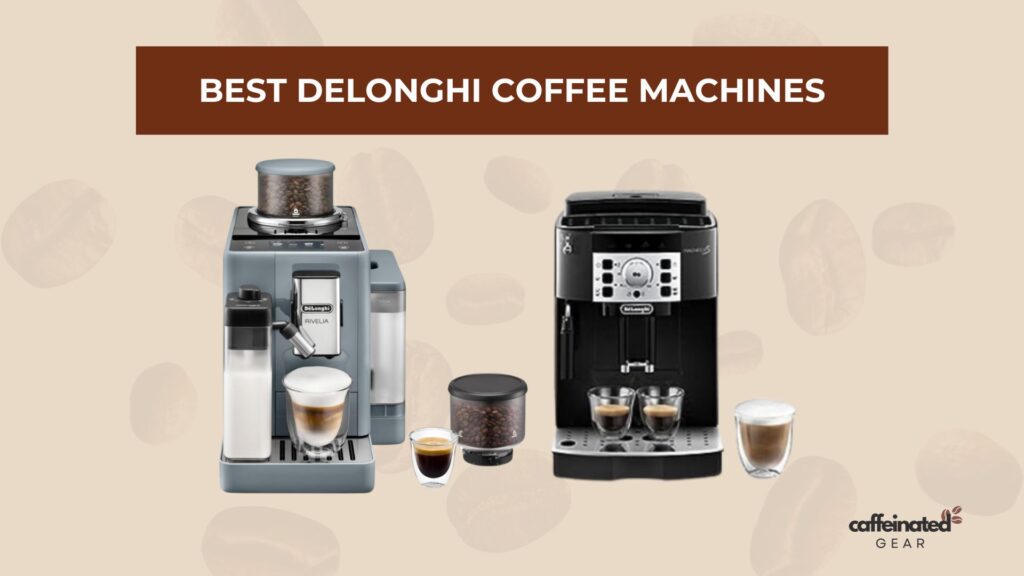
After countless hours testing DeLonghi’s extensive range of coffee machines in our dedicated testing kitchen, we’ve discovered why this Italian powerhouse dominates the global coffee scene. Our team of certified baristas and coffee experts has put these machines through their paces to help you find your perfect match.
DeLonghi’s remarkable journey from a modest Italian family workshop to commanding an impressive 33% of the global espresso machine market speaks volumes about their commitment to quality. Our testing revealed why they’ve maintained such dominance in a fiercely competitive market against giants like Sage, Gaggia, and other premium manufacturers.
We were particularly impressed by DeLonghi’s dedication to innovation, investing roughly forty million Euros annually in research and development. This commitment shows in their latest models, which we’ve thoroughly evaluated in our test kitchen. And yes, they even managed to secure Brad Pitt as their brand ambassador!
For our UK readers, there’s excellent news: DeLonghi machines here offer outstanding value compared to other markets. Through our international testing, we’ve noticed these same machines often cost twice as much in places like the United States, even post-Brexit.
We’ve spent months comparing different DeLonghi models to identify which machines truly deserve your attention. Our testing revealed that some models with different names share remarkably similar features, so we’ll help you navigate these distinctions to find the best value for your money.
Let’s break down the different types of DeLonghi coffee machines, starting with their manual espresso range.
While traditional manual machines require significant skill to master, DeLonghi has brilliantly balanced professional capabilities with user-friendly features. These machines can produce excellent espresso and its variations – from lattes to flat whites, cappuccinos to Americanos.
Watch our detailed guide on crafting the perfect flat white:
Unlike professional-grade home barista machines, DeLonghi’s manual espresso machines are engineered for everyday home use. While you’ll still follow the traditional steps – grinding, tamping, and pulling shots – these machines are designed to help beginners achieve satisfying results from day one.
A crucial point we’ve learned through extensive testing: while pre-ground coffee might seem convenient, it significantly impacts your coffee’s quality. Our experts strongly recommend grinding your own beans for the best possible espresso experience.
For more insights on getting the most from your coffee beans, explore our detailed guides:
Through our testing, we’ve consistently found that using pre-ground coffee with a manual espresso machine limits its potential. Fresh grinding is absolutely essential for achieving cafe-quality results at home. In fact, across all brewing methods – whether it’s filter coffee, French press, AeroPress, or stovetop – freshly ground, high-quality speciality beans make the biggest difference to your cup’s quality.
Want to explore the world of coffee further? Check out our detailed guides on:
For grinding perfection, we’ve got you covered:
Every DeLonghi manual espresso machine includes a built-in steam wand for milk heating and frothing, eliminating the need for a separate milk frother.
We should mention that choosing this path requires some dedication to learning proper coffee-making techniques. From our experience testing hundreds of machines, achieving cafe-quality results takes practice and understanding.
Our testing has shown that producing coffee shop quality drinks means mastering grind size adjustment and understanding extraction ratios. We typically aim for a 1:2 ratio (18g coffee to 36ml espresso) with an extraction time between 28-32 seconds.
It’s worth noting that DeLonghi machines often come with pressurised baskets, which simplify the process. For a deeper dive into this topic, see our guide:
If this sounds too technical but you still want excellent coffee without the fuss, you might prefer the next category of machines.
While DeLonghi labels these as automatic coffee machines, they’re better known in the UK market as bean to cup machines.
Watch our detailed video on bean to cup machine types:
After testing numerous models, we’ve found two main categories: automatic and fully automatic (or one-touch) machines. The key difference? Fully automatic models handle milk frothing automatically, while standard automatic machines require manual milk steaming with the steam wand. Standard machines are only “one-touch” for espresso preparation.
These machines feature integrated grinders – just fill the hopper (bean container) on top, and fresh grinding happens automatically for each drink. However, we should clarify that having a built-in grinder doesn’t automatically make it a bean to cup machine.
DeLonghi’s La Specialista range, for instance, includes traditional espresso machines with integrated grinders. The crucial distinction lies in the brewing mechanism: true bean to cup machines use automated brewing units for dosing and tamping, unlike traditional machines with their manual groups and portafilters.
Bean to cup machines win praise for their simplicity. Our testing shows maintenance is straightforward – just keep the bean hopper filled, water tank topped up, and regularly empty the drip tray and used coffee drawer.
While you can adjust grind settings (though usually limited), brew temperature, and drink volumes, the process remains largely automated. Semi-automatic models require manual milk steaming, but we’ve found this surprisingly manageable. Fully automatic machines simplify this further – just keep the milk carafe filled and clean.
From our extensive testing experience, we’re somewhat hesitant about one-touch “cappuccino maker” systems. As passionate coffee professionals, we value proper microfoam texture for silky flat whites, and these systems often fall short in milk texturing quality.
An important observation from our testing: higher prices in fully automatic machines don’t necessarily mean better espresso. Most manufacturers, including DeLonghi, use similar grinders and brewing units across their range. The price difference typically reflects additional features rather than improved coffee quality.
While this guide focuses on DeLonghi, if you’re interested in exploring other brands, check out our comprehensive guide:
While DeLonghi produces several filter coffee machines, they’re primarily known for their espresso makers. For those interested in filter coffee options, we’ve created a detailed guide:
Here’s an interesting fact we discovered: while Nespresso is the brand name, they rarely manufacture their own machines. Instead, various companies, including DeLonghi, produce Nespresso machines under licence.
This explains why you might see DeLonghi branding on a Nespresso machine – it’s a Nespresso machine manufactured by DeLonghi rather than a DeLonghi original design.
While this article focuses on DeLonghi’s manual espresso and bean to cup machines, we’ve created a comprehensive guide to Nespresso systems:
Dolce Gusto targets the budget-conscious end of the capsule coffee market, unlike Nespresso’s premium positioning. While you can find Dolce Gusto machines under £50, our professional testing experience makes us hesitant to recommend them. The capsules prove costly over time, and their powdered milk “cappuccinos” and “lattes” fall short of authentic coffee shop quality.
Though DeLonghi produces some Dolce Gusto machines, we’re focusing on their other ranges here. For more details about these systems, see our comparison:
Before making your decision on a DeLonghi machine, we’d like to mention our exclusive discount code for Sage coffee machines:
After extensive testing in our speciality coffee lab, we’ve compiled our definitive guide to DeLonghi’s bean-to-cup coffee machines.
We’ve spent countless hours grinding, brewing, and tasting to bring you our expert assessment of each model’s capabilities.
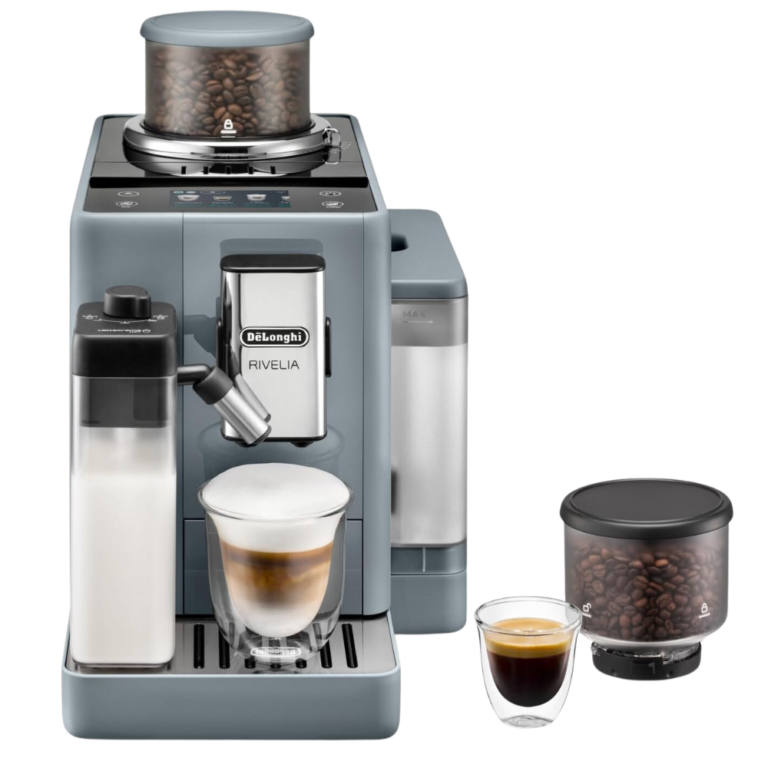
In our professional opinion, the Rivelia stands head and shoulders above other bean-to-cup machines currently available.
The milk texturing capabilities genuinely surprised our entire testing team.
For the first time in a bean-to-cup machine, we witnessed genuine microfoam rather than the typical aerated bubbles these machines usually produce.
When we tested the “hot milk” setting with our precision milk pitchers, we achieved what can only be described as a perfect modern microfoam cappuccino.
We conducted our tests using Moma Oat milk, which performed brilliantly.
By fine-tuning the froth settings, we created what might be the most impressive flat white we’ve seen from an automated machine:
The milk temperature sits at 60-62°C, which we find ideal for preserving the natural sweetness of the milk.
Our espresso testing has been equally impressive.
Using our chocolate brownie blend as a control, the shots pulled were remarkably consistent and flavourful.
The dual hopper system impressed us with its practical design.
When switching between beans, you can choose to either use the remaining grounds or purge them – brilliant for households mixing decaf and regular beans.
The optional iced coffee feature adds another dimension, offering cold-frothed milk drinks that actually work.
For our complete analysis, see our detailed write-up:
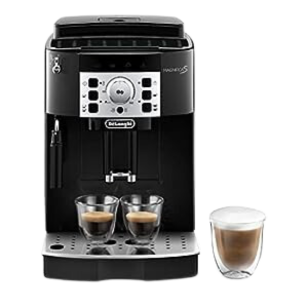
This machine offers remarkable value, delivering professional features at a more accessible price point.
Its popularity speaks volumes – the substantial number of positive reviews on Amazon reflects genuine user satisfaction with the machine’s performance.
This model requires manual milk steaming, which we actually prefer for greater control over milk texture.
The versatile steam wand can be used with or without the Panarello attachment, allowing both beginners and those developing their barista skills to create their perfect milk drinks.
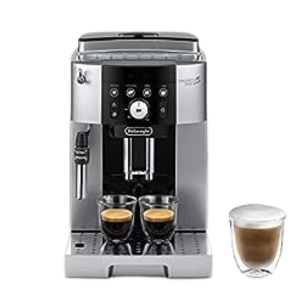
The Magnifica range includes several similar models, including the Magnifica S 21 and the Magnifica S 22, with minor aesthetic variations.
The S Smart’s distinguishing feature is its innovative steam wand design.
While it uses a Panarello system for foolproof milk texturing, it adds a clever dual-mode functionality.
This intelligent design offers both cappuccino and hot milk settings, controlling the air intake for different textures.
For those wanting to develop their steaming technique, removing the Panarello reveals a traditional steam pipe.
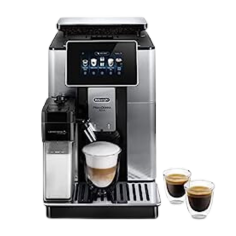
The Magnifica range consistently impresses us with its value proposition.
This newest addition brings premium features to a competitive price point, as reflected in its growing popularity and positive user feedback.
We’re reviewing the carafe version here, but there’s also a semi-automatic version with a steam wand at a lower price point.
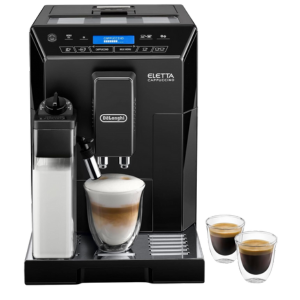
After extensive testing in our coffee lab, we’ve found this fully automatic bean-to-cup machine offers remarkable versatility with its dual milk-frothing capabilities.
What impressed us most during our trials was its ability to satisfy different user preferences through both automatic and manual milk preparation methods.
The inclusion of a Panarello wand alongside the automatic milk system might seem puzzling at first glance.
However, our real-world testing revealed this dual-system approach brilliantly serves mixed households where different users have varying comfort levels with coffee preparation.
This flexibility proved particularly valuable in our office environment, where some team members preferred the convenience of one-touch operation while others enjoyed crafting their milk texture manually.
We discovered the Panarello wand serves as an excellent backup when you’re short on time or the milk carafe needs cleaning.
Speaking of outstanding milk systems, while we’re discussing DeLonghi, it’s worth noting our experience with the Sage Bambino Plus’s remarkable automatic milk texturing system.
Drawing from our industry experience, we’ve seen why DeLonghi has become the world’s largest home espresso machine manufacturer.
Their attention to user needs shows in their consistently popular designs.
While this machine has garnered numerous positive Amazon reviews, we noticed some users questioned its ability to produce authentic flat whites.
Based on our professional testing, we should be frank about automatic machines and flat whites – they typically create something closer to a stronger cappuccino.
Through our extensive testing of bean-to-cup machines, we’ve found only three models that truly master automatic flat white preparation:
We understand customer disappointment when marketing promises don’t align with results.
However, we should note that flat white definitions vary widely – even among high-street coffee shops.
What sets this machine apart is its three distinct foam texture settings, offering more control than typical one-touch machines.
Considering its feature set, we find it provides good value for its price point.
This premium offering from DeLonghi’s Primadonna range represents their cutting-edge technology in home coffee automation.
For additional high-end options, see the ECAM650.85.MS Primadonna Elite.
Our thorough testing revealed this machine isn’t just about impressive specifications.
When examining detailed Amazon reviews, including video demonstrations and photos, we found consistent praise for both coffee quality and milk texturing capabilities.
While our team generally prefers semi-automatic machines for their greater control over grind settings and milk texturing, this model impressed us with its performance.
The smartphone integration adds genuine convenience, though we had to chuckle – even the cleverest app can’t place your cup under the spout.
The Bean Adapt system showcases DeLonghi’s commitment to smart brewing technology.
Through extensive testing, we’ve found this feature particularly impressive for its ability to guide users through the bean customisation process.
Here’s how it works: you start by using the provided shade card to identify your beans’ roast level – light, medium, medium-dark, or dark.
The app lets you specify whether you’re working with pure Arabica or an Arabica/Robusta blend.
Once you’ve saved your coffee details, the real magic begins.
Simply tap the edit icon, press “start,” and the system walks you through a personalised dialling-in process.
You’ll pull a shot and provide feedback on crucial factors like crema appearance and taste profile (noting if it’s too weak, just right, or overly bitter).
Based on your input, the machine fine-tunes both brewing temperature and grind size.
Want to perfect it further?
The app allows continuous adjustments until you achieve your ideal espresso.
As specialists who typically prefer traditional brewing methods, we must admit – this intelligent system genuinely impressed us during our tests.
Let’s talk about traditional semi-automatic (or pump) espresso machines.
These beauties operate just like the commercial machines you’ll spot in professional coffee shops.
The process mirrors what you’d see a skilled barista perform: grinding fresh beans into the portafilter basket, carefully tamping the grounds, locking the portafilter in place, and extracting that liquid gold.
For straight espresso lovers, you’re done right there.
Fancy an Americano?
Add hot water.
For milk-based drinks like lattes, flat whites, cappuccinos, or cortados, you’ll use the steam wand to texture your milk before combining it with the espresso.
Now, we need to be straight with you – while this might sound wonderfully simple, there’s more to consider.
Making coffee this way demands genuine barista skills, and the learning curve varies based on your taste preferences and palate sensitivity.
If you’re new to espresso or less particular about subtle flavour notes, most entry-level machines come with a pressurised basket that can work with pre-ground coffee.
But remember – even this simplified approach requires practice.
For those who cherish perfectly extracted espresso and silky milk texture (our flat white enthusiasts will understand!), prepare for a steeper learning curve.
You’ll want to switch to a standard basket, invest in a proper espresso grinder, and develop solid barista techniques.
The journey involves precision tools like brewing scales for weighing both grounds and shots, mastering shot timing, and understanding proper extraction techniques.
You’ll learn about even distribution, consistent tamping, preventing channeling, and the art of dialling in beans through grind size adjustments.
If you catch the home barista bug like many of our team members have, you’ll discover a rewarding hobby that produces coffee shop quality (often better, actually) drinks at home.
However, if this sounds overwhelming, you might find yourself frustrated and listing your machine online rather quickly.
We strongly recommend considering your commitment level before choosing a manual espresso machine.
If the thought of this learning process makes you anxious, a bean-to-cup machine might better suit your needs.
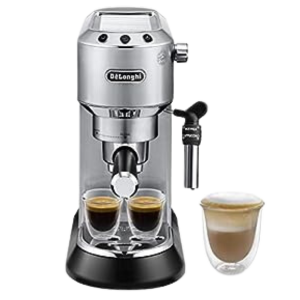
The DeLonghi Dedica EC685 builds upon its predecessor, the EC680, offering a compelling entry point into the world of manual espresso making.
Our team considers this a consumer-focused machine that, with some thoughtful modifications, can punch well above its weight class.
Let’s put this in perspective: the serious home barista market typically begins with machines like the
which command prices starting around £400.
From there, prices quickly climb into the £1,000-£2,000 range and beyond for premium domestic equipment.
We know many coffee enthusiasts face this common dilemma: how to start exploring proper espresso without breaking the bank?
One route we’ve seen work well is hunting for pre-loved equipment – though finding a bargain Gaggia Classic these days is increasingly challenging, with used models still fetching close to £200.
The alternative? Starting with a consumer-grade machine like the Dedica EC685.
For casual users, the included pressurised baskets work perfectly fine.
But here’s where it gets interesting: pair this machine with a quality grinder and some minor modifications, and you’ve got yourself a capable starter setup.
The most straightforward upgrade we recommend is switching to a standard basket or investing in a bottomless portafilter that includes one, like this:
We tested this specific portafilter during our hands-on review, which you can watch here:
Through extensive testing, we’ve found that decent espresso is absolutely achievable with this machine, though you’ll need to work around its 15-bar pressure system.
Without an over-pressure valve (OPV) – a feature typically found on prosumer machines – you’re dealing with higher pressure than ideal.
This can increase the likelihood of channeling, where water finds the path of least resistance through your coffee puck, resulting in uneven extraction.
However, with proper technique and attention to detail, we’ve pulled some surprisingly good shots.
While we view the Dedica EC685 as more of a stepping stone than a forever machine for serious enthusiasts, it serves admirably as an affordable entry point.
Where this machine truly shines, in our experience, is milk steaming.
Unlike typical domestic machines with basic Panarello wands (often called turbo frothers), the Dedica’s dual-mode steam wand offers genuine versatility.
As certified baristas, we can attest that proper milk steaming is a challenging skill to master.
Traditional Panarello wands simplify the process but typically produce only stiff, cappuccino-style foam.
The Dedica EC685’s innovative two-setting system, however, allows for both traditional cappuccino foam and silkier microfoam suitable for flat whites and lattes.
Watch our detailed tutorial here:
A quick note for those eyeing the Smeg ECF01: our testing suggests it shares significant internal similarities with the Dedica EC685.
While the Smeg offers attractive aesthetics and a steam lever control, we find it difficult to justify its substantial price premium for what appears to be largely cosmetic differences.
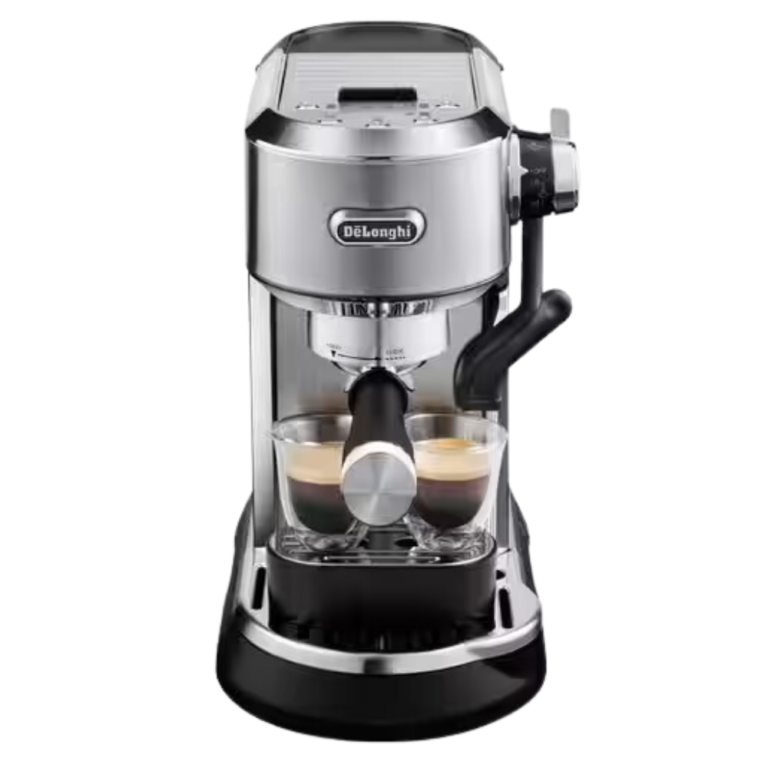
As professional baristas and coffee equipment specialists, we’ve put the DeLonghi Dedica Maestro Plus through its paces in our testing lab.
Let’s start with the technical specifications before diving into our hands-on experience with this machine.
The rapid heating system is clearly DeLonghi’s response to competitors like the Bambino Plus with its 3-second heat-up time.
However, we should point out that these lightning-fast heat-up claims need context.
While the machine might reach brewing temperature quickly, you’ll still need time to heat the portafilter and other components for optimal extraction.
We were particularly impressed with the 51mm portafilter’s quality.
For this price point, it’s refreshingly robust compared to the basic plastic-heavy options typically found on entry-level machines.
The temperature control system (often called a PID) deserves special mention.
This sophisticated component maintains precise brewing temperatures through constant monitoring and adjustment.
Finding an adjustable temperature controller at this price point is quite rare, giving the Dedica Maestro Plus a notable advantage.
Regarding the pre-infusion feature, we should clarify something important.
While marketed as pre-infusion, it’s actually a puck pre-wetting system.
True pre-infusion, found in plumbed commercial machines, uses mains water pressure (2-3 bars) before the pump engages.
The Dedica Maestro Plus, like many home machines, simulates this with pump pulsing.
The cool-touch steam wand proved to be one of our favourite features.
Beyond the obvious safety benefits, we found it significantly easier to clean than traditional wands since milk doesn’t burn onto the surface.
The automatic steaming feature offers excellent versatility with its three temperature and texture settings, matching the capabilities of pricier competitors.
The auto-purge function helps maintain wand cleanliness, which we consider essential for longevity.
While the storage compartment seemed promising initially, our testing revealed some practical limitations we’ll discuss in detail later.
We were pleasantly surprised by the included tamper’s quality.
While serious enthusiasts might still opt for an aftermarket upgrade, it’s notably better than the basic plastic tampers usually bundled with machines in this category.
The cup riser serves double duty as both a height adjuster and secondary drip tray, showing thoughtful design consideration.
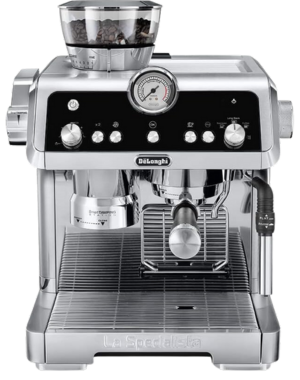
Our testing revealed that while this machine has an integrated grinder, it shouldn’t be confused with a bean-to-cup system.
It’s a distinction we often need to clarify, as this misconception frequently leads to the Specialista and Sage Barista Express Review being incorrectly categorised.
In our assessment, the Specialista represents DeLonghi’s response to Sage coffee machines, but with a crucial difference – it’s engineered specifically for everyday coffee enthusiasts rather than aspiring home baristas.
Having extensively tested both ranges, we’ve observed that while Sage dominates the home barista market with their integrated grinder machines, DeLonghi has created something quite different with the Specialista.
The pressurised basket system significantly reduces the learning curve, making it ideal for those new to espresso making.
While this might not appeal to coffee perfectionists, it’s perfect for users seeking consistently good results without extensive training.
The technical distinction lies in the basket design – pressurised baskets work with 15 or 19 bar pumps and feature a single exit hole, creating visually appealing shots even with less precise preparation.
Traditional baskets, with their multiple holes, require more skill but can produce superior results when used correctly.
Through careful side-by-side testing, we found that Gaggia and Rancilio machines can achieve better espresso quality, but only with proper technique and practice.
The Specialista, however, delivers consistently acceptable results right out of the box.
A standout feature is the enclosed grinder cradle – it’s genuinely innovative.
The automated dosing and grinding process happens entirely within the machine, eliminating mess and simplifying operation.
The smart tamping lever ensures consistent pressure every time, removing another variable from the equation.
We also appreciate the automated hot water delivery for Americanos, streamlining the entire drink-making process.
However, we should note that our research into user experiences revealed some early models had water leakage issues.
While the overall review scores remain strong, suggesting these problems have been addressed, it’s worth mentioning.
After extensive testing and analysis, we can confidently say that DeLonghi excels in creating machines for everyday coffee enthusiasts.
Their focus on user-friendly features and reliable performance makes them an excellent choice for most home users.
Before concluding, let’s address some common questions:
As coffee industry professionals, we can confirm DeLonghi’s position as a market leader isn’t just about sales figures.
Their substantial investment in product development and consumer research shows in their machines’ performance.
Currently the world’s highest-selling coffee machine brand, DeLonghi has earned its reputation through consistent quality and innovation.
For mainstream domestic coffee machines, we rate them as industry leaders.
For those interested in more specialised equipment, we recommend exploring
Based on our experience servicing and testing these machines, longevity largely depends on maintenance and usage patterns.
Think of it like car ownership – regular maintenance significantly impacts lifespan.
With proper care, including regular descaling and cleaning according to the manual’s instructions, we typically see DeLonghi machines lasting 5+ years.
This impressive lifespan reflects their build quality and engineering standards.
For more detailed insights, see:
Welcome to our comprehensive guide to DeLonghi coffee machines! Our team of certified baristas and coffee specialists at Caffeinated Gear has spent countless hours testing and evaluating these popular machines. We’re thrilled to share our professional insights to help you make the perfect choice for your home brewing setup.
Before we dive in, we’d love to offer you an exclusive 25% discount on premium coffee beans, with free delivery when you order two or more bags. Our carefully curated selection includes dark, medium-dark, and light-medium roasts, each bringing unique flavour profiles to your cup.
Based on our extensive testing and industry experience, a well-maintained DeLonghi coffee machine should serve you faithfully for 3-5 years at minimum, with many models reaching the impressive 5-10 year mark or beyond.
The significant variation in lifespan primarily comes down to one crucial factor: water hardness.
Here’s what our testing has revealed:
In soft water regions, these machines often exceed their expected lifespan. However, hard water areas present more challenges, requiring frequent descaling that, while necessary, can impact the machine’s internal components over time – particularly the rubber seals and O-rings.
Pro Tip: Consider using low-TDS bottled water like Tesco Ashbeck, which mirrors the calcium levels found in the UK’s softest water regions. This simple switch can significantly reduce descaling frequency and potentially extend your machine’s life.
The correct pod choice depends entirely on your specific DeLonghi model’s brewing system:
For DeLonghi bean-to-cup machines, our testing consistently shows that medium-dark roasts work best. However, we should note that roast descriptions can vary significantly between suppliers – what we classify as medium-dark might differ from supermarket labels or small-batch roasters.
Critical advice: Avoid using beans with visible oil on their surface. These typically appear shiny and indicate a dark roast that’s gone through second crack. Such beans can leave oily residue on the grinder burrs, potentially leading to clogs. This becomes particularly problematic in machines with non-removable burrs, which might require professional servicing if clogged.
Through our research and industry connections, we’ve confirmed that DeLonghi operates manufacturing facilities across multiple countries, including China, Romania, and Italy. While production location varies by model and manufacturing year, it’s worth noting that all facilities maintain DeLonghi’s strict quality control standards and operational procedures.
DeLonghi maintains complete control over their coffee machine production through their network of dedicated manufacturing facilities worldwide. While Giuseppe De’Longhi serves as chairman, the company operates state-of-the-art production plants in various locations, including China and Romania, ensuring consistent quality across all their coffee machine lines.
Caffeinatedgear.com is a participant in the Amazon Services LLC Associates Program, an affiliate advertising program designed to provide a means for sites to earn advertising fees by advertising and linking to amazon.co.uk.
© 2025 Caffeinated Gear.