

By: The Caffeinated Gear Team
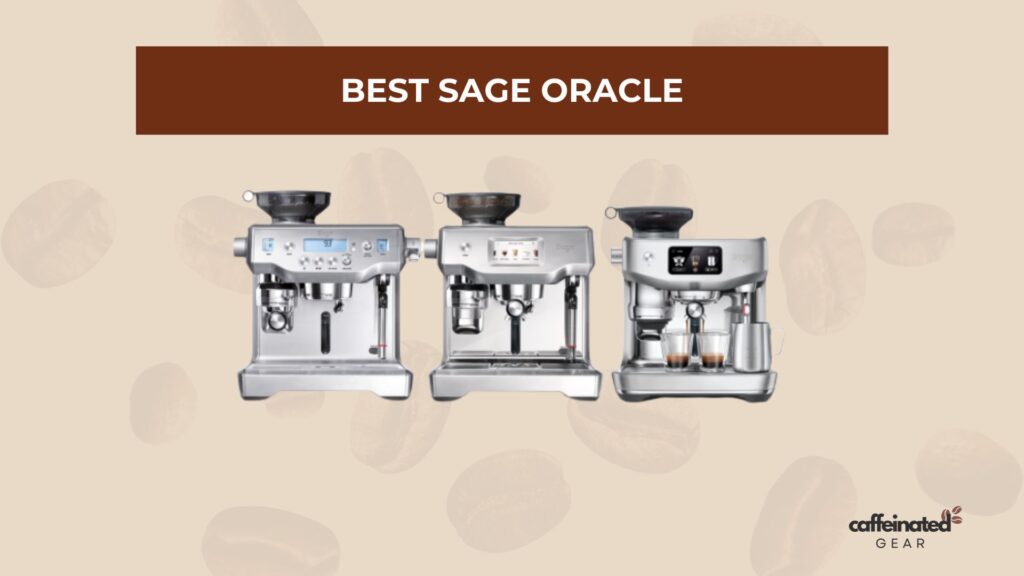
After countless hours of testing and brewing thousands of shots, we’re sharing our comprehensive analysis of the entire Sage Oracle lineup.
This detailed review combines our hands-on experience with all three Oracle models: the classic Oracle, the innovative Oracle Touch, and the cutting-edge Oracle Jet.
We’ve decided to compile everything into one thorough guide since we know many coffee enthusiasts struggle to choose between these premium machines.
Before diving into the detailed reviews, you might want to skip to our click here section for direct comparisons.
For a quick overview, check our “Oracle Vs Oracle Touch Vs Oracle Jet” breakdown first.
Our relationship with Sage spans many years, and we’ve watched them grow into a powerhouse in the home espresso machine market.
Their commitment to excellence shows in every interaction – from product support to innovation in coffee technology.
Our YouTube channel has grown tremendously, surpassing 7 million views, allowing us to test and review countless coffee machines.
This extensive experience has given us unique insights into what makes a truly exceptional espresso machine.
What sets Sage (known as Breville outside the UK) apart is their genuine dedication to speciality coffee.
They’ve consistently shown that they understand both the science and art of coffee brewing.
This authentic passion for quality coffee, combined with their innovative technology, explains why you’ll find numerous Sage machine reviews across our platform.
We believe in complete transparency with our readers.
While we appreciate Sage’s commitment to quality and innovation, we never let brand relationships influence our honest opinions.
Our reputation is built on providing thorough, unbiased reviews that help coffee enthusiasts make informed decisions.
This approach has earned us the trust of both our readers and manufacturers, who value our detailed, straightforward assessments.
After all, a review is only useful if it tells the complete story – both strengths and weaknesses.
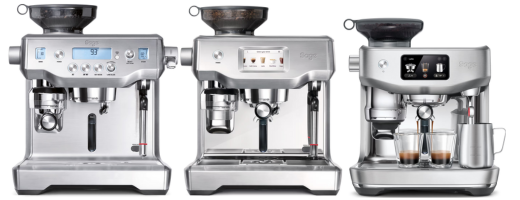
Looking to choose between Sage’s premium Oracle machines? Let us guide you through the key differences between these remarkable coffee makers, drawing from our extensive testing experience.
The original Oracle builds upon the exceptional foundation of the Sage Dual Boiler, which we consider one of the finest dual boiler espresso machines available today. While the Dual Boiler requires separate grinding equipment and substantial barista knowledge, Sage recognised a gap in the market.
Our team noticed that many coffee enthusiasts wanted professional-grade results without the technical complexity. Enter the Oracle – Sage’s answer to this exact need.
The Oracle Touch came next, designed for those seeking an even more streamlined experience with enhanced guidance and automation.
Then there’s the Oracle Jet – matching the Touch’s capabilities (and in some areas, surpassing them) but using thermojet heating instead of dual boilers. This makes it particularly suited to households making just one or two drinks at a time.
For those primarily brewing smaller quantities, the dual boiler systems (which need longer heating times) might be unnecessary. In fact, during our testing, we found the Oracle Jet could prepare two flat whites before the Oracle Touch had finished its initial warm-up.
However, if you regularly serve 4-6 consecutive drinks, the dual boiler systems truly shine. The Jet, meanwhile, perfectly suits those wanting premium features and outstanding drinks but typically brewing in smaller quantities.
Worth noting: the Oracle Jet, being the newest addition, brings some brilliant innovations not currently found in its siblings.
Now, let’s examine each machine in detail.
We recommend reading our Oracle review below, even if you’re leaning towards the Touch or Jet. We’ve included comprehensive information about shared features across all models, clearly noting where specifications apply to multiple machines to avoid repetition.
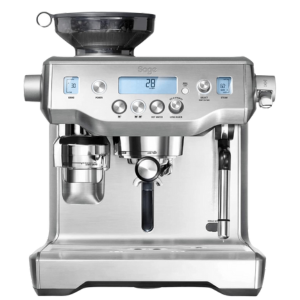
As mentioned, the Oracle builds on the foundation of the Sage Dual Boiler.
When paired with a quality grinder and operated by someone with basic barista skills, the Dual Boiler can produce exceptional espresso-based drinks rivalling your favourite café’s offerings.
But what if you want brilliant coffee without the learning curve or separate grinder faff?
If you’re content with the milder drinks typically produced by fully automatic machines, a bean-to-cup model might suit you perfectly. These machines dominate the market thanks to their simplicity and consistent results.
If this sounds like you, check out:
However, if you’ve developed a taste for genuine espresso, most automatic machines might fall short. That’s precisely why our team at Caffeinated Gear understands the appeal of the Oracle’s middle ground.
For those interested in developing their home barista skills, we recommend:
A key distinguishing feature of the Oracle and Oracle Touch is their dual boiler system.
Most automatic machines use thermoblocks rather than boilers. The primary difference becomes apparent when making multiple drinks.
The Oracle features separate boilers for brewing and steaming. This allows simultaneous milk steaming and espresso extraction, plus faster milk heating overall.
While most automatic machines heat up quicker than the Oracle (which itself beats most dual boiler machines), the Oracle’s workflow advantage becomes clear when preparing multiple drinks.
Our testing shows that dual boiler systems typically offer superior temperature stability and precision compared to thermoblock machines – crucial factors for exceptional espresso.
The premium price point? Much relates to the boiler system. Replacement boilers alone cost around £420, compared to £20-£30 for typical thermojet heaters.
Next to temperature control, grind quality and precision determine espresso excellence.
Grind quality refers to particle distribution – ideally achieving a high percentage of grounds within a narrow size range, minimising both too-fine and too-coarse particles.
All current Sage integrated grinder machines feature European Etzinger burrs, matching those in the Baratza Encore ESP. Our testing confirms these rank among the finest burrs in integrated systems.
Regarding precision, the Oracle and Oracle Touch offer 45 grind settings (the Jet differs slightly). This vastly outperforms typical automatic machines’ 5-10 settings, allowing proper dialling in with the traditional portafilter system, though this requires manual adjustment.
All three Oracles handle one of espresso-making’s trickiest aspects: dosing and tamping.
Simply insert the portafilter, and the machine precisely grinds, doses, and tamps your coffee using a specialised tamping fan system. This differs from the lever-based approach in the Sage Barista Touch Impress and Barista Express Impress.
Each Oracle offers automatic or manual milk steaming through the “Auto MilQ” system. The Jet adds special presets for dairy and three alternative milk types.
You’ll enjoy precise control over texture and temperature for each drink. Manual steaming provides even more control (with some practice), maintaining temperature monitoring on screen.
The Oracle and Oracle Touch need roughly 6 minutes to heat up – impressive for dual boiler machines but slower than most automatics.
For occasional coffee drinkers making one or two drinks, a dual boiler might be unnecessary. The real advantages emerge when preparing three or more drinks consecutively.
Frequent entertainers might prefer the Oracle or Oracle Touch, while those typically brewing solo or for two might find the Jet more practical.
For coffee connoisseurs seeking café-quality results without compromise, all three Oracles deliver – provided you’re using quality beans.
This applies to both espresso quality and milk texturing. Temperature control extends to 75C – which our baristas consider far too hot for optimal milk, but the option exists for those who prefer it.
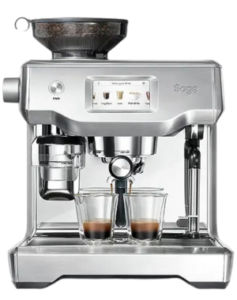
Having extensively tested both machines in our coffee lab, we can confidently say that while the Oracle Touch mirrors the Oracle’s exceptional cup quality, it brings a whole new dimension to the user experience.
The touch screen integration transforms this machine from brilliant to extraordinary.
Our testing revealed that while the Oracle’s setup process is straightforward, the Touch version takes user-friendliness to new heights with its video-guided interface.
The interactive experience extends throughout every aspect of the machine’s operation, from adjusting settings to crafting your perfect brew.
Scheduling Capabilities
A notable advancement in the Touch model is its sophisticated scheduling system.
While the standard Oracle offers a single auto on/off schedule (similar to the Sage Dual Boiler), the Touch version quadruples your options with four distinct scheduling slots.
This enhancement proved invaluable during our testing, particularly for varied weekly routines.
Picture this: you could programme your machine to wake up at 7am on weekdays, switch to a leisurely 9am weekend schedule, and even add afternoon warm-ups for those weekend coffee sessions.
This flexibility truly shines for coffee enthusiasts with structured daily routines.
It’s worth noting that the Oracle Jet doesn’t include scheduling – but there’s good reason for this, as it requires no warm-up time.
Interactive Guidance
Another standout feature of the Touch screen (shared with the Oracle Jet) is its comprehensive video tutorials and customisable display options.
Through our testing, we’ve found that the value of these features largely depends on your experience level and learning style.
For our seasoned team members, these guides weren’t essential.
Yet, we’ve observed how these interactive elements transform the learning curve for newcomers.
Rather than wrestling with printed manuals, users can follow clear, visual instructions right on the machine.
The interactive menu system makes exploring and adjusting settings remarkably intuitive.
Coffee Preparation Experience
The Touch version (and Jet) streamlines the coffee-making process considerably.
Simply tap your desired beverage, activate the grinder (either by tapping or pushing the portafilter), then initiate the espresso and milk preparation with separate taps.
Each drink type comes with pre-programmed settings for milk texture and temperature.
This automation marks a significant improvement over the standard Oracle, where manual adjustments are needed when switching between drinks.
For instance, when crafting both a cappuccino and a flat white, the Touch remembers different milk texture settings for each drink automatically.
The customisation options really shine here.
You can create and save personalised drink profiles with specific parameters.
This proves particularly useful in households with different preferences – imagine creating a custom flat white profile with lower temperature and intensity for your partner.
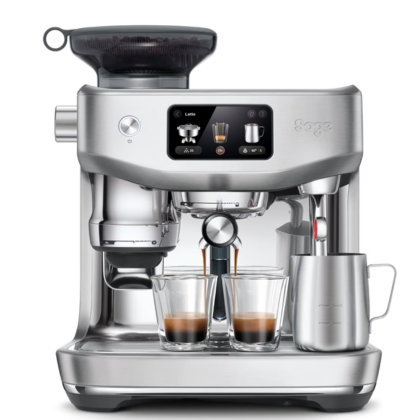
Our initial assessment of the Oracle Jet required a complete rethink of what we expected from Sage’s premium range.
The absence of dual boilers initially raised eyebrows among our testing team.
However, after thorough testing, we can confidently say this machine deserves its place in the Oracle family – and perhaps even deserves its own category entirely.
The Oracle Jet represents a significant leap forward in Sage’s lineup of automated coffee machines.
In fact, for most home users, we believe it’s their most impressive offering to date.
The technological advancements aren’t mere gimmicks – they translate into practical benefits:
Choosing Between the Oracle Jet and Touch
As your coffee guides, we’ll make this decision straightforward:
The Oracle Touch requires about 6 minutes to reach operating temperature – impressively quick for a dual boiler system.
This warm-up time pays dividends when preparing multiple drinks, offering excellent energy efficiency for larger batches.
Combined with its four scheduling options, the Touch becomes ideal for households with predictable coffee routines and multiple drinks per session.
The Jet, however, caters to a different style of coffee enthusiast – those who prefer spontaneous brewing sessions of one or two drinks at a time.
Speed Comparison
The question of speed isn’t straightforward.
From a cold start, the Jet can produce two milk-based drinks in roughly 4.5 minutes – before the Touch would even finish heating up.
For smaller batches, the Jet actually proves faster.
However, when preparing 4-6 consecutive drinks, the Touch’s dual boiler system demonstrates its superiority, outpacing the Jet significantly.
One clever feature worth highlighting is the Jet’s auto-queuing system.
This intelligent workflow management means you’re not tied to the machine during preparation.
For example, selecting an Americano automatically queues the hot water to follow your espresso.
Similarly, when making milk-based drinks, the shot pulls automatically after milk steaming completes.
We’ve developed an efficient workflow during our testing:
Start the milk steaming (the longest process), initiate the grind, lock in the portafilter, and queue the shot.
By the time the milk finishes, you have just enough time to perfect the milk texture while the espresso extracts.
Grinder Innovation – Stepless Precision
The Oracle Jet’s new grinder might be the most sophisticated we’ve seen in an integrated machine.
While we’re still conducting detailed particle distribution analysis (and comparing it with the Lelit Anita & Kate), its capabilities are impressive.
The key innovation is its stepless adjustment system.
Though marketed with 45 grind settings like its siblings, it actually offers infinite adjustment between these digital reference points.
These 45 positions serve more as landmarks than limitations.
Currently, there’s a minor interface limitation – adjustments only display on screen when they’re substantial enough.
We’re optimistic this will be addressed through firmware updates, potentially transforming the grinder’s usability.
Each digital reference point represents about 60 degrees of rotation, or roughly 2cm of dial circumference.
Theoretically, this could translate to a thousand distinct settings.
While such minute adjustments might seem excessive, they could prove valuable for precision dialling.
For instance, current setting 25 might translate to 550 on an expanded scale, offering unprecedented fine-tuning capability.
Whether Sage will implement such extensive adjustment remains to be seen, but the WiFi update capability means it’s certainly possible.
The Oracle Jet’s inclusion of WiFi capability has proven to be a genuine game-changer in our testing.
Initially, our team was sceptical about yet another ‘smart’ coffee machine feature.
Most app-connected coffee machines raise practical questions – like the simple fact that you still need to physically place your cup under the spout.
However, the WiFi implementation here serves a much more practical purpose: automatic firmware updates.
This means your investment keeps getting better over time.
Imagine missing out on an expanded range of grind settings or new brewing features simply because you couldn’t update your machine?
Our team has already compiled a wishlist for Sage, including advanced features like ratio-based volume control and other specialist brewing parameters.
The beauty of the WiFi system is that when new features roll out, everyone benefits – whether you bought your machine last week or last year.
We’ve already seen this in action with the new double-tap features – quick-press the grinder icon for a preset purge, or the brew icon for a hot water group purge.
The Oracle Jet offers built-in grinding guidance during setup, suggesting finer or coarser adjustments as needed.
Our initial experience with the barista guidance system left us wanting more.
While it works during the initial setup phase, we found it surprisingly quiet afterwards – even when we deliberately pulled problematic shots ranging from 11 seconds to over 60 seconds.
We put the system through its paces – toggling the assistance on and off, even performing a complete factory reset – but the behaviour remained unchanged.
For a premium assisted machine, we expected ongoing guidance similar to what we’ve seen in machines at a third of the price, like the Ninja Luxe Cafe.
Another oversight in the setup process is the lack of prompting for grind purging after size adjustments.
Our testing confirmed this can lead to poorly dialled-in initial shots, as the previous grind settings affect the next extraction.
While this likely stems from the fact that the double-tap purge feature came via a later WiFi update, it needs addressing in future updates.
For now, our advice is simple: breeze through the setup phase, then make your actual adjustments followed by two double-taps of the grinder icon (purging about 8-10g), before pulling your first proper shot.
Aim for that sweet spot between 20-30 seconds initially.
The Oracle Jet brings new capabilities absent from earlier Oracle models: cold brew-style coffee and cold pressed espresso.
These functions use pulsed, lower-temperature water with extended brew times.
While hardcore cold brew enthusiasts might debate the terminology, we’ve found these features produce enjoyable cold coffee drinks.
As mentioned in our Ninja Luxe Cafe review, it won’t replace traditional cold brew methods, but it’s brilliant for occasional iced coffee cravings.
One missing feature is cold milk frothing – something we’ve suggested to Sage for future updates, possibly using the air pump without steam.
The water delivery system has seen a significant redesign from previous Oracle models.
Unlike the Oracle and Oracle Touch’s pouring spout, the Jet uses a thinner, angled nozzle similar to the Barista Pro.
This change matters more than you might think, especially for Americano lovers.
The stronger stream can cause splashing when adding water to espresso.
Our simple solution? Add water first – you’ll still get splashes, but they’ll be clear rather than coffee-coloured.
The Jet’s touchscreen has thoroughly impressed our team, despite our usual preference for physical controls.
The display offers exceptional responsiveness and visual quality, with practical features like drag-and-drop drink reordering and easy customisation options.
We appreciate the new easy-access wheel for movement, though the drip tray capacity is notably smaller than its predecessors.
The tamping fan runs slightly louder, though it doesn’t exceed the grinder’s volume.
Current firmware doesn’t allow pre-infusion customisation like earlier Oracles, though future updates might change this.
Size-wise, it’s roughly 6cm slimmer and 3cm shorter, maintaining the same depth.
Let’s break down the key differences to help you decide.
The Oracle Jet suits coffee enthusiasts who typically make one or two drinks at a time and prefer flexibility in their brewing schedule.
The Oracle and Oracle Touch excel at higher volumes, offering faster milk steaming and simultaneous brewing capabilities.
While the Jet can handle volume (averaging 90 seconds per milk drink with a full dose), the original models shave off 20-30 seconds per drink.
Energy efficiency varies too.
Our testing shows thermojet machines primarily use power during active brewing and steaming.
Dual boiler systems consume most energy during initial heating, then maintain temperature with minimal power draw.
For occasional coffee drinkers, the Jet proves more energy-efficient, while frequent brewers might benefit from the Oracle or Touch.
The Jet’s smaller drip tray space affects split-shot brewing into two cups.
While workarounds exist (using narrower cups or shot measures), this might matter if you regularly prepare multiple drinks simultaneously.
When choosing between dual boiler models, consider the Touch’s four auto on/off schedules.
While both interfaces become intuitive with use, the Touch offers superior flexibility for households with varying preferences.
The Touch particularly suits multiple users with different taste preferences, while single users with consistent habits might find the original Oracle perfectly sufficient.
Our extensive testing shows the Oracle Jet performs brilliantly, though with a slightly different timing profile.
While the thermojet system takes a few extra seconds compared to the traditional dual boiler setup, the final milk quality is remarkably similar.
Through our hands-on experience, we’ve found that the thermojet technology actually offers some advantages for manual steaming.
The slightly gentler steam power gives you more control over the process, which can be particularly helpful when you’re developing your milk texturing technique.
As professional baristas and coffee educators, we have to be honest about this – latte art requires significant dedication regardless of your equipment.
The journey to mastering latte art is a long one, and we speak from years of experience teaching barista skills.
Our team includes former café baristas who spent countless hours perfecting their pouring technique.
What makes the Sage Oracle series special isn’t that it makes latte art effortless – because nothing does – but rather that it provides consistently textured milk.
This consistency removes one of the major variables in the latte art equation, giving you a reliable foundation for practising your technique.
Here’s a look at the learning curve you might expect:

The difference between initial attempts and skilled pours is striking.
Here’s what months of dedicated practice can achieve:
The Oracle machines won’t magically transform you into a latte art champion, but they do provide the consistently textured milk that’s essential for developing your skills.
From our experience training both home enthusiasts and professional baristas, we’ve found that reliable milk texture is absolutely crucial for the learning process.
The automatic milk texturing system removes one of the most technically challenging aspects of the process, allowing you to focus entirely on your pouring technique.
As experienced baristas, we know that ‘dialing in’ can be intimidating for newcomers to home espresso.
This crucial process involves fine-tuning various parameters to achieve the perfect shot.
While there are multiple factors to consider, the grind size remains the most critical variable.
All Oracle machines simplify this process by automating crucial variables through their built-in smart system.
This intelligent automation handles precise tamping and dosing, significantly reducing the variables you need to manage.
The Oracle Jet takes this innovation a step further with its advanced grinding guidance system.
While this feature sounds brilliant for beginners, our extensive testing reveals that the grind guidance still needs refinement.
Fortunately, the WiFi connectivity allows for firmware updates, which we believe is essential for improving this particular feature.
Our testing shows impressive shot quality across all three Oracle models.
Though we haven’t completed direct side-by-side comparisons yet, our professional assessment indicates remarkably similar output quality.
The Oracle Jet’s stepless grinder adjustment might give it a slight advantage, despite using the same burr set.
However, shot-to-shot consistency remains a challenge – not due to machine limitations, but because of espresso’s inherent nature.
Through extensive testing, we’ve identified several factors affecting consistency, including ambient temperature fluctuations, humidity’s effect on beans, and subtle changes in equipment performance during warm-up.
Despite trying various solutions, we’ve found that minor grind adjustments throughout the day are simply part of the espresso-making process.
We believe the Oracle Jet could better assist users by recommending grinder purging between adjustments and providing ongoing guidance beyond initial setup.
Manual milk steaming is absolutely possible on all models – simply pull out the steam wand to switch to manual mode.
While the fixed-position wand limits jug positioning somewhat, the built-in thermostat provides real-time temperature readings on screen – a feature we find invaluable for both automatic and manual steaming.
This temperature display helps perfect your technique.
For consistent results, we recommend starting aeration (creating the characteristic ‘ripping paper’ sound) until the milk reaches 30°C.
Then raise the jug slightly to stop aeration and continue heating while distributing the microfoam.
A gentle tap breaks larger bubbles, and a quick swirl creates that glossy finish perfect for latte art.
If your milk texture isn’t quite right, try adjusting your aeration time – extend to 35°C for thicker foam, or reduce to 28°C for a lighter texture.
All three Oracle machines work brilliantly with any freshly roasted beans, though we particularly recommend medium to dark roast espresso blends for optimal results.
When we mention “freshly roasted,” we’re not just being coffee snobs.
These sophisticated machines are specifically engineered for freshly roasted coffee beans, featuring standard espresso baskets.
While some home espresso machines use pressurised filter baskets to create artificial crema (that lovely golden foam on top), making every shot look perfect regardless of bean quality or age, the Oracle series takes a different approach.
If you’re considering investing in a machine of this calibre, we’re confident you have a refined palate that wouldn’t be satisfied with artificial results.
Using standard supermarket beans in these traditional baskets likely won’t deliver the exceptional coffee experience you’re after.
Fortunately, the speciality coffee scene is thriving.
Small-batch roasters and speciality coffee suppliers are readily available, offering exceptional beans at prices that often surprise our customers – they’re typically just marginally more expensive than supermarket varieties.
We recommend starting with blends rather than single-origin beans.
Our testing shows blends are more forgiving and easier to work with while you’re mastering your machine.
This isn’t to discourage you from single-origin coffees – they’re brilliant but better approached once you’re comfortable with your equipment.
Let’s be crystal clear: you shouldn’t.
While technically possible, it goes against everything these machines are designed for.
The Oracle series features standard, traditional espresso baskets rather than pressurised (dual-walled) ones, making them specifically intended for use with their integrated grinders.
For decaf lovers wondering about pre-ground options, we suggest buying high quality freshly roasted decaf and storing it properly.
This brings us naturally to our next point:
Our team is frequently asked about changing between different beans, including decaf, and we’re pleased to report it’s wonderfully straightforward.
The process involves a simple twist of the hopper lock at the top, which simultaneously secures the beans inside while releasing the hopper from the machine.
We recommend storing your beans in an airtight container between uses.
When switching, if there are just a few beans left in the hopper (especially if they’ve been there overnight), we suggest starting fresh.
A quick vacuum of the burrs helps ensure a clean transition between beans.
These machines come with a two-year manufacturer’s warranty, after which Sage Appliances directs you to their designated repair partner.
You might spot online discussions about the minimum repair fee for diagnostics and potential fixes.
In our experience, this is less problematic for Oracle range owners than those with lower-priced models, given the initial investment in these premium machines.
While Sage’s official repair partner is one option, we’ve found numerous qualified independent engineers and companies capable of servicing these machines.
For those seeking a trusted repair specialist, we recommend contacting Radu at: espressorepaireshop.co.uk.
The Oracle, Oracle Touch, and Oracle Jet don’t fit the traditional definition of bean-to-cup machines, though marketing terminology is evolving.
Historically, “bean-to-cup” meant fully automatic machines requiring just one button press for your coffee.
We prefer to distinguish between automatic bean-to-cup machines and integrated-grinder espresso machines, which more accurately describes the Oracle range.
These machines are essentially traditional portafilter espresso makers with built-in grinders and sophisticated electronics.
They’re designed to deliver genuine barista-quality drinks without requiring years of coffee-making expertise.
If you’re seeking café-quality coffee and perfectly textured milk for speciality drinks, without turning coffee-making into a full-time hobby, the Oracle range hits the sweet spot.
For more information about different machine types, explore our guides:
Let’s tackle the elephant in the room: Oracle machines represent a significant investment for any home barista.
While they sit comfortably below the price point of commercial machines, they still command a premium price tag.
As the Caffeinated Gear team, we’re often asked whether these machines justify their cost.
The answer boils down to your personal coffee priorities.
If you’re seeking café-quality espresso, exceptional microfoam, and the convenience of professional-grade brewing at home—all while using quality beans—then we believe these machines offer genuine value.
Our testing shows they can match (and sometimes exceed) the output of many high-street coffee shops.
During our extensive testing, we found the Touch Impress to be quite impressive, sharing several features with the Oracle Jet.
The innovative MilQ system, practical hot water spout, and helpful barista assistance features are present in both machines, alongside a smart touch screen interface that guides you through the brewing process.
However, there are notable differences in the design approach.
Instead of the Oracle’s automated tamp distribution fan, you’ll find a manual tamp lever on the Touch Impress.
The Oracle Jet brings additional refinements with its professional 58mm group head, an upgraded high-definition touch screen, and the ability to receive WiFi updates.
We discovered an interesting limitation in the Touch Impress menu system.
When you want to modify existing drink settings, you can’t simply adjust and save them as the default – you’ll need to create an entirely new drink preset.
For instance, if you’re fine-tuning the milk texture of your flat white, you’ll have to save it as a separate drink with a new name rather than updating the original preset.
The Oracle Jet’s new interface offers more flexibility in this regard.
You can store up to 10 custom drinks (compared to the Touch Impress’s 8), and importantly, you can modify and save changes to the pre-set menu drinks – a significant improvement in our view.
The customisation options extend further, allowing you to remove drinks from the menu and rearrange them to prioritise your favourites.
Additional personalisation features include adjustable barista light brightness, customisable audio chime levels, screen brightness control, and a choice between light and dark display modes.
Our community feedback highlighted an accessibility concern – the font size appears quite small relative to the screen size.
We’ve already communicated this to Sage, suggesting they implement a font size adjustment option for improved visibility.
Price-wise, there’s a significant difference – the Luxe Premier 601 comes in at roughly a third of the Oracle and Oracle Jet’s price point, and even less compared to the Oracle Touch.
Through our testing, we identified some unique advantages of the Luxe.
It offers cold milk frothing capabilities, produces filter-style coffee, and provides more vertical space for taller travel mugs.
Currently, we’ve noticed the Luxe’s barista guidance system actually outperforms the Oracle Jet in some aspects.
However, we expect this gap to close soon.
Given the Oracle Jet’s superior processing capabilities, we anticipate a WiFi firmware update that will enhance its grinding adjustment suggestions beyond the current fixed recommendations.
When it comes to overall quality, the Oracle machines clearly operate in a different league.
The espresso extraction and milk texturing capabilities surpass those of the Luxe.
A common question we see in forums and comments asks if they’re worth three to four times the price.
While this is subjective, we believe the quality difference isn’t quite that dramatic – the Luxe produces surprisingly good results.
However, the comparison goes beyond just cup quality.
The substantial price difference reflects variations in build quality and user experience.
Based on our industry expertise, we believe the Oracles may offer better long-term value when considering average machine lifespan.
This assessment might change if Ninja develops a robust parts supply chain and repair infrastructure similar to Sage’s established network.
We’ll continue monitoring this development and update our analysis accordingly.
Caffeinatedgear.com is a participant in the Amazon Services LLC Associates Program, an affiliate advertising program designed to provide a means for sites to earn advertising fees by advertising and linking to amazon.co.uk.
© 2025 Caffeinated Gear.