

By: The Caffeinated Gear Team
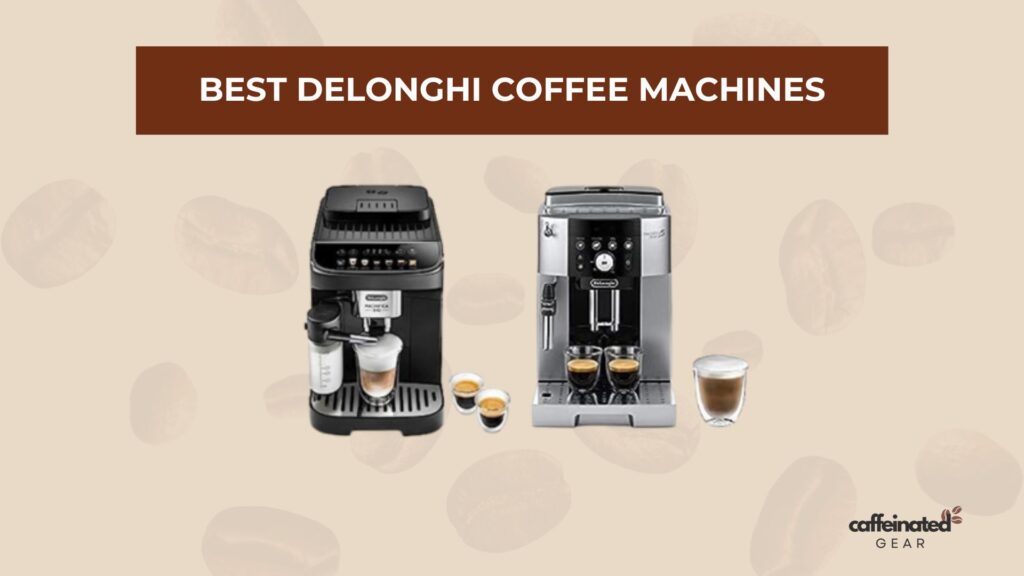
Choosing between DeLonghi’s bean-to-cup coffee machines can feel like navigating a complex maze of features and specifications. As coffee professionals who’ve spent countless hours testing these machines, we’re here to guide you through the key differences between the Magnifica, Dinamica, and Prima Donna ranges.
Our team has thoroughly tested each DeLonghi range to help you understand exactly what you’re getting at each price point. Whether you’re considering the entry-level Magnifica or the premium Prima Donna, we’ll help you make an informed choice based on your specific needs.
While our primary focus is comparing the Magnifica, Dinamica, and Prima Donna ranges, we’ve also included the Maestosa in our analysis. Through our testing, we’ve identified specific scenarios where this premium machine truly shines, despite its higher price point.
We’ll break down each range systematically, highlighting the standout models within each category. Rather than overwhelming you with every minor variation, we’ve focused on the models that offer meaningful differences in features and functionality.
Here’s something that might surprise you: The price tag of a bean-to-cup machine has minimal impact on the actual coffee quality.
This revelation often catches coffee enthusiasts off guard, but our extensive testing confirms it. Think of it like choosing a luxury car – you’re not necessarily paying more for better performance, but rather for additional features and convenience.
To illustrate this point, imagine shopping for a premium SUV. While acceleration might factor into your decision, you’re likely more focused on practical features like cargo space, seating capacity, and comfort features. Similarly, when you invest in a more expensive bean-to-cup machine, you’re primarily gaining convenience features rather than better espresso.
Remember, the true secret to exceptional coffee lies in your choice of beans. Just as a high-performance vehicle needs quality fuel to reach its potential, your bean-to-cup machine requires fresh, high-quality coffee beans to produce outstanding results.
When it comes to bean-to-cup coffee machines, we’ve discovered something fascinating during our extensive testing: spending more money doesn’t necessarily mean better espresso quality.
Think of it like this: just as a budget-friendly car can get you from A to B just as effectively as a luxury model, the core espresso-making capabilities of bean-to-cup machines remain remarkably consistent across price points. What you’re really paying for are the extra features and conveniences.
For traditional espresso machines, where skill and technique play crucial roles, investing more can genuinely improve your coffee quality. We’ve seen this firsthand in our traditional espresso machine testing – once you’ve mastered the basics, higher-end equipment can take your coffee to new heights.
Bean-to-cup machines, however, work differently. These clever devices combine a grinder with an automated brewing unit – the two components responsible for espresso quality. Through our testing, we’ve found that these core components remain surprisingly similar across different price points and even different brands.
Whether you’re looking at DeLonghi, Gaggia, Krups, Melitta, or other manufacturers, the fundamental grinding and brewing mechanisms share remarkable similarities. Within the same brand, these components are often identical across different models – you’re paying extra for features rather than better coffee.
This brings us to the Magnifica range – what we consider the sweet spot in DeLonghi’s lineup for value-conscious coffee lovers. If you’re after excellent coffee without unnecessary frills, the lower end of the Magnifica range offers exceptional value for money.
Traditionally, the Magnifica series has championed simplicity and affordability. These machines typically featured manual steam wands and straightforward controls. However, the latest “Evo” model marks an interesting departure, introducing touchscreen controls and one-touch milk frothing, while maintaining a competitive price point. Don’t worry if terms like steam wands and milk carafes seem confusing – we’ll explain everything as we go along.
For more comprehensive information about DeLonghi’s range, see our:
For comparison with other brands, check out our detailed review of the Brera:
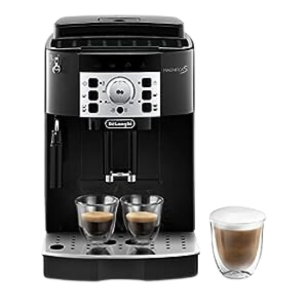
During our hands-on testing, we found the Magnifica S to be a refined evolution of the original Magnifica design. While maintaining the same height at 36cm (perfect for fitting under standard kitchen cabinets), DeLonghi has cleverly reimagined the machine’s footprint.
The newer design trades width for depth – it’s 45mm slimmer but 65mm deeper than its predecessor. We think this makes perfect sense for modern kitchens, where counter width is often more valuable than depth.
In our testing lab, we noticed the Magnifica S runs noticeably quieter than the ESAM 4200’s distinctly powerful pump. The volume control has been modernised too, replacing the traditional dial with an intuitive press-and-hold button system.
For milk frothing, you’ll find a standard “Panarello” steam wand. While this produces larger-bubbled cappuccino foam rather than fine microfoam, we discovered a brilliant workaround: simply remove the Panarello attachment to use the steam pipe as a traditional single-hole wand, perfect for creating silky microfoam for flat whites.
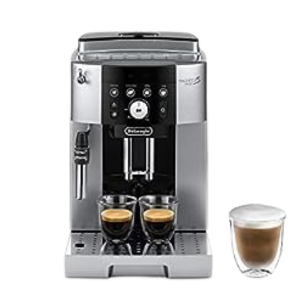
The standout difference between the Magnifica S and S Smart lies in its innovative steam wand technology. It shares the same clever system as the DeLonghi Dedica EC685, which we’ve found to be remarkably versatile.
This brilliant piece of engineering features an adjustable Panarello sheath with two settings. Start with “cappuccino” mode for aeration, then switch to “hot milk” mode to continue heating and creating that perfect milk vortex. For those who prefer traditional steaming, the Panarello can be removed entirely.
Pro tip from our testing: If you remove the Panarello, the rubber pipe might occasionally pop off (which can be quite startling!). We’ve found a simple cable tie works perfectly to keep it securely in place.
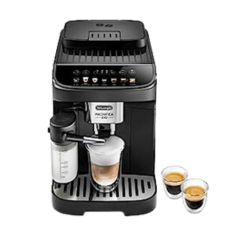
In our extensive testing, we’ve found this model brilliantly bridges the gap between simplicity and automation. It’s essentially a one-touch version of the newer Magnifica machines, featuring an intuitive colour touch screen interface.
The machine specialises in latte macchiato preparation, steaming milk first before adding coffee to create those distinctive layers. While it won’t create latte art (though we wish it could!), it offers unmatched convenience for those who want their milky coffees at the touch of a button.
However, our experience shows that the automated milk system trades control for convenience. For coffee enthusiasts particular about milk texture and temperature, we recommend choosing a model with a manual steam wand instead.
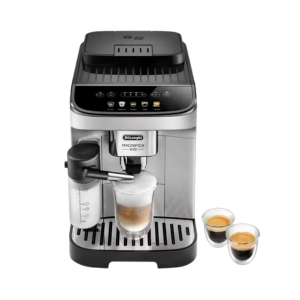
Through our testing, we’ve observed that while the Magnifica range prioritises value and simplicity, the Dinamica series targets those seeking enhanced convenience and sophistication.
Most Dinamica machines feature integrated milk carafe systems for true one-touch operation. Simply store the milk-filled carafe in your fridge, attach it when needed, and press a button for your preferred drink.
For serious milk-based coffee lovers (like several members of our team), it’s worth noting that while modern automatic frothers offer some customisation, they can’t match the precise control of a manual steam wand. The Dinamica range does include one steam wand version, but most models feature the convenient milk carafe system with more sophisticated controls than typical Magnifica machines.
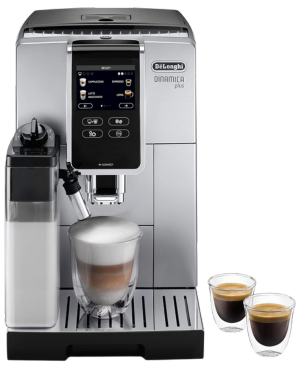
The Dinamica Plus showcases some clever design refinements – it’s slightly more compact than the latest Magnifica models, measuring 4mm thinner, 11mm shallower, and 12mm shorter.
One of its main attractions is the expanded range of one-touch milk-based drinks, including flat white. However, during our testing, we’ve found that the term “flat white” can be somewhat misleading. While the machine makes a perfectly pleasant drink, achieving the silky microfoam texture that defines a true flat white is challenging with an automated system.
In our extensive café testing, we’ve encountered many drinks labeled as flat whites that are essentially stronger cappuccinos. While the Dinamica Plus offers this popular drink option, those seeking the perfect flat white texture might want to consider a machine with manual milk steaming capabilities.
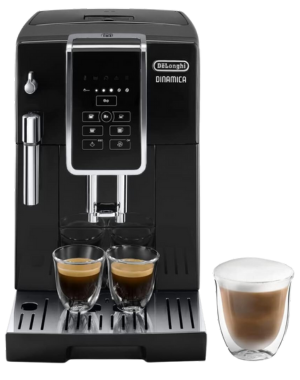
During our extensive testing of this Dinamica model, we found its standard Panarello steam wand sets it apart from its milk carafe counterparts. While this means you won’t get one-touch cappuccinos, our baristas actually prefer this setup for crafting the perfect milk texture.
The steam wand gives you brilliant control over milk temperature, and here’s a pro tip we discovered: remove the Panarello attachment to use the steam pipe directly for complete control over milk texturing. For coffee enthusiasts who take their milk-based drinks seriously, this machine offers better value than its automatic-milk counterparts.
The Primadonna represents DeLonghi’s premium range of bean-to-cup machines. Through our testing and research, we’ve found these machines blend impressive technology with striking aesthetics. The name ‘Primadonna’ comes from opera, meaning ‘first lady’, and these machines certainly command attention in any kitchen setup.
Each Primadonna model offers full automation with one-touch operation. The range stands out with colourful touch displays and smart connectivity through DeLonghi’s coffee app. We’ve put countless hours into testing these machines to understand what sets them apart from standard bean-to-cup options.
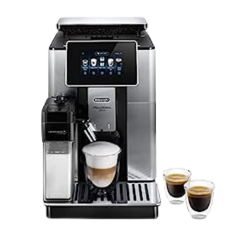
As coffee professionals, we recognise that while this is an entry-level Primadonna machine, its price tag of around £1,000 might raise eyebrows. However, we’ve found it offers excellent value when compared to the Primadonna Elite’s higher price point.
Through our testing experience, we’ve learned that price doesn’t always correlate directly with coffee quality in bean-to-cup machines. Take the ESAM 4200, for instance – it produces comparable coffee to the pricier Dinamica range. We’ve seen numerous cases of budget-friendly machines lasting over a decade with proper care.
What you’re investing in with this machine is convenience and variety. Here’s the complete list of one-touch drinks we’ve tested:
For coffee lovers seeking variety and convenience, our team understands why this machine proves so popular.
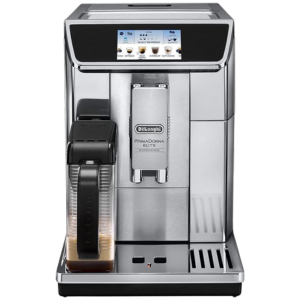
The Elite’s standout feature, which our team thoroughly tested, is its integrated touch screen and impressive cold coffee capabilities. The cold frother (or whipper) particularly caught our attention, as it’s a feature we typically see in commercial machines like Crew Machines.
Our baristas were genuinely impressed by the cold milk froth quality. It creates a remarkably creamy texture that tricks the palate into thinking you’re drinking something much more indulgent than cold milk.
We’ve also extensively tested its hot chocolate function. While any machine can technically make hot chocolate, the Elite’s dedicated settings produced notably better results in our trials.
The Maestosa stands out in our testing as one of the rare domestic machines featuring dual grinders. This unique design solves a common household challenge we’ve identified: switching between regular and decaf beans, or accommodating different taste preferences.
Most machines offer a bypass chute for pre-ground coffee as their solution to this problem. However, our coffee experts strongly advise against this approach, particularly for decaf drinkers.
Watch our post on how to correctly deal with Decaf:
Based on our expertise, pre-ground coffee deteriorates rapidly, making it a poor choice for occasional use. The dual grinder system offers a superior solution to the split-hopper designs we’ve tested, where cross-contamination between beans is inevitable.
In fact, we’ve only encountered one other domestic dual-grinder machine: the Siemens EQ9 S700.
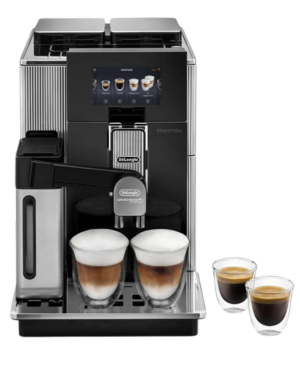
Our team’s thorough testing of the Maestosa revealed its impressive capabilities. Beyond the dual grinders, it features both a cold milk whipper and hot chocolate settings. The touch-screen grind adjustment system is unique, though we noticed it requires 5-6 coffees before grind changes become noticeable in the cup.
This observation led our technicians to identify significant grind retention – coffee particles remaining in the grinder between uses. This actually reinforces why dual grinders are superior to split hoppers for switching beans. With a single grinder system, you’d need to waste several shots before achieving a pure brew of your new beans.
While some might suggest buying two separate machines instead, our practical experience shows the Maestosa’s space-efficient design is a significant advantage for many households.
The DeLonghi coffee app adds convenient remote control features, including brew temperature adjustments and drink customisation. However, our testing revealed some connectivity challenges – a common issue we’ve encountered across various coffee machine apps, including the Marzocco Linea Mini. Users should expect occasional reconnection requirements, even with this premium machine.
After extensive testing of DeLonghi’s range, our team of baristas has found that the value of upgrading to a Dinamica depends largely on your specific needs.
When it comes to pure espresso quality, you might be surprised to learn that upgrading from one bean-to-cup machine to another won’t dramatically improve your coffee.
However, if you’re seeking additional features and functionality, the Dinamica offers several advantages over models like the Magnifica.
Our hands-on experience with the Primadonna range has shown that its value proposition centres on its advanced features rather than coffee quality alone.
As DeLonghi’s premium offering (sitting just below the Maestosa), the Primadonna stands out for its extensive drink options and innovative cold milk froth function.
Before investing, we recommend comparing the specific features between the Primadonna and other models you’re considering to determine if the additional capabilities justify the price difference for your needs.
Through our comparative testing, we’ve found that these machines share most core features.
The key distinctions of the Plus version are:
In our side-by-side comparison, we noted that the Magnifica S represents a refinement of the original Magnifica design with several practical improvements:
Our detailed measurements and testing revealed these key differences:
Based on our extensive testing and comparison of DeLonghi’s bean-to-cup range, we’ve observed that espresso quality remains fairly consistent across models.
This consistency stems from the similar grinder and brewing unit designs used across the range, meaning your choice should focus more on features and functionality rather than expecting significant differences in espresso quality.
Caffeinatedgear.com is a participant in the Amazon Services LLC Associates Program, an affiliate advertising program designed to provide a means for sites to earn advertising fees by advertising and linking to amazon.co.uk.
© 2025 Caffeinated Gear.