

Caffeinated Gear » Best Coffee Grinders Review: Expert Guide to Perfect Home Grinding
By: Caffeinated Gear Review Team

After countless hours testing coffee grinders in our specialised lab, we can say with complete certainty: investing in a quality coffee grinder will revolutionise your home brewing experience.
Having a proper grinder isn’t just a luxury—it’s absolutely essential for achieving cafe-quality coffee at home.
Many coffee enthusiasts initially make the same mistake we did: focusing solely on the brewing equipment while overlooking the crucial role of the grinder.
This is particularly true when it comes to espresso, where we often see people investing heavily in sophisticated machines while pairing them with inadequate best coffee grinders.
Our team of certified baristas and coffee experts has thoroughly tested dozens of grinders across all price ranges and brewing styles.
We’ve discovered what works, what doesn’t, and most importantly—which grinders offer the best value for different coffee brewing needs.
This comprehensive guide draws from our real-world testing experience, not just theoretical knowledge.
To help you navigate this detailed review efficiently, we’ve organised it into clear sections based on your specific needs and budget.
Below you’ll find quick links to key sections, followed by a detailed comparison table.
For an in-depth look at any particular grinder, simply scroll to its dedicated review section.
Price point serves as the primary differentiator between coffee grinder categories, though other factors like build quality and grinding mechanism also play significant roles.
Important Note: This guide focuses exclusively on electric coffee grinders.
For information about manual options, please see our detailed guide on
Let’s address the elephant in the room: blade grinders aren’t truly grinders at all—they’re essentially coffee choppers.
Our extensive testing has shown that burr grinders are definitely way better than blade grinders in every measurable way.
While we’re not enthusiastic about blade grinders due to their inconsistent results and harsh operation, we’ve included them in our review for an important reason: they represent the most affordable entry point into fresh grinding.
In our professional opinion, even using a blade grinder to process fresh beans typically yields better results than pre-ground coffee—though the margin isn’t substantial.
Our advice? If your budget allows for even a modest increase, investing in a basic burr grinder will significantly improve your coffee experience.
Through our testing, we’ve identified a distinct category of budget grinders that use what manufacturers call “grinding wheels.”
These grinders share two key characteristics:
Our lab tests reveal these machines crush rather than grind beans, similar to a mortar and pestle.
While they achieve better consistency at finer settings, they still can’t match the particle uniformity of proper burr grinders.
We consider them a modest improvement over blade grinders, but they’re still far from ideal for serious coffee enthusiasts.
The entry-level burr grinder category offers surprisingly capable options, typically starting around £80.
These machines feature genuine burrs—usually stainless steel and conical in design—and perform admirably for most brewing methods.
However, our testing revealed a crucial limitation: most entry-level models struggle with espresso grinding, particularly for traditional baskets requiring very fine grounds.
We’ve also noticed a concerning trend with lesser-known brands: durability issues and limited warranty support beyond standard return windows.
Many of these models appear briefly under one brand name, vanish, then resurface under another—a pattern worth considering before purchase.
This category represents the sweet spot for serious coffee enthusiasts, offering the widest selection of specialized equipment.
These grinders feature premium burr sets—both conical and flat—and tend to focus on specific brewing methods (either filter coffee or espresso, with some versatile exceptions).
We’ve noticed an increasing trend towards single-dose designs in this segment, catering to home baristas who prioritize precision and minimal waste.
While we strongly recommend investing in a proper burr grinder, we understand that budget constraints sometimes necessitate compromises.
Before reviewing specific models, it’s crucial to understand the limitations of blade grinders: they produce notably inconsistent grounds, creating a mix of fine powder and larger chunks. Without adjustable settings, your only control over grind size is the duration of grinding.
Our professional recommendation: If possible, skip ahead to the burr grinder sections. However, if your budget is strictly limited, here’s our assessment of the most viable blade grinder option:
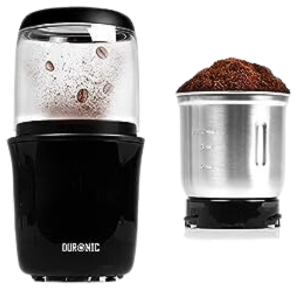
During our extensive testing of blade grinders, the Duronic CG250 emerged as the most practical option in this category—though that’s admittedly a modest achievement.
Its standout feature is the removable grinding chamber, which significantly improves the workflow compared to fixed-chamber models we’ve tested. This design choice makes transferring grounds to your brewing device notably more convenient.
Fundamentally, these devices are miniature blenders with rotating blades—more suited to spice grinding than coffee preparation.
We need to address some misleading marketing claims about this grinder. It’s advertised as suitable for espresso, cappuccino, and Americano brewing. This requires clarification:
First, cappuccino and Americano are espresso-based drinks, not distinct brewing methods. More importantly, claiming this grinder works for “espresso” requires context.
Traditional espresso preparation demands extremely precise grinding capability—something blade grinders simply cannot provide. However, this grinder can produce grounds fine enough for pressurized (dual-wall) baskets, which are common in budget espresso machines (£50-£150 range).
For context, mid-range barista espresso machine models like the Gaggia Classic Pro and Sage Bambino Plus include both traditional and pressurized baskets. This gives you the flexibility to:
While this grinder has garnered numerous positive reviews, we must view them in context of its price point. The removable grounds chamber is genuinely helpful, and in our testing, using this grinder with fresh beans typically produced better results than pre-ground coffee—though the margin of improvement isn’t dramatic.
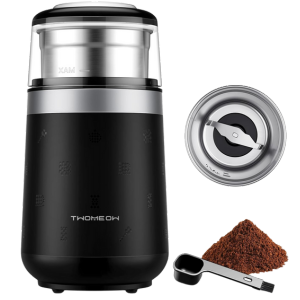
Quirky name aside, this model stands out as a more sophisticated version of our previously discussed blade grinder. While it shares the convenient removable grounds container, it brings additional precision to the table with its multiple timer settings.
We particularly appreciate the timer dial feature during our testing. Rather than mentally tracking grinding duration for different coffee styles, you can simply set and forget. Once you’ve discovered your ideal grind timing for different brewing methods, you can lock in that setting for consistent results every time.
Let’s explore what we call “grinding wheel” grinders. While marketed as burr grinders—and yes, they do technically contain burrs—manufacturers often label them as having “grinding wheels”. Our hands-on experience with these models reveals their defining characteristic: circular grinding disks with relatively dull edges.
During our detailed inspections (we’ve dismantled several models), we’ve noticed that the sharpest parts are actually the screw heads securing the burrs in place.
While these grinders outperform blade models, they still fall short of traditional burr grinders. Given that the price difference can sometimes be minimal, we strongly recommend investing just a bit more to access entry-level proper burr grinders, which we’ll discuss in the following sections.
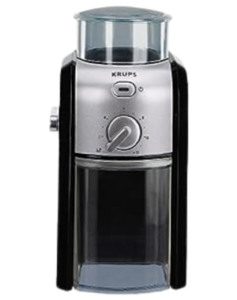
The Krups GVX231 holds a significant place in coffee grinding history, being what we believe is the original grinding wheel model (though DeLonghi might contest this with their KG79). With nearly two decades in the market, it’s established quite a legacy.
While there’s a newer version available—the G VX2 42—we find its higher price point hard to justify, especially when it costs more than some entry-level proper burr grinders offering superior grinding technology.
Our testing reveals that despite the theoretical advantage over blade grinders, these blunt grinding wheels primarily crush rather than grind the beans. Traditional burr grinders use sharp-edged burrs that precisely cut beans into uniformly-sized particles. In contrast, these dull wheels tend to shatter the beans, resulting in inconsistent particle sizes.
We’ve examined both this Krups model and the DeLonghi below in detail, and they’re remarkably similar—down to identical plug manufacturers. Whether they share production facilities remains unclear, but their performance and build quality are nearly indistinguishable.
Here’s crucial information about espresso grinding: like other grinders in this price range, it won’t achieve the fineness required for unpressurised baskets. During our testing with a Blue Coffee Box sample, we compared results using three grinders: the Sage Smart Grinder Pro, this Krups model, and the De’Longhi KG79.
The Smart Grinder Pro delivered excellent results with plenty of adjustment room (we used setting 16, far from its finest). However, both the Krups GVX231 and De’Longhi KG79 couldn’t achieve the fineness needed for standard baskets, resulting in under-extracted espresso.
For pressurised (dual-walled) baskets, these grinders perform adequately. If you’re using a budget espresso machine with pressurised baskets, both the Krups and De’Longhi models will serve your needs—just don’t expect them to work with traditional baskets.
For other brewing methods like pour-over, filter coffee machines, and AeroPress, these grinders can achieve suitable grind sizes. However, we still recommend investing in a proper burr grinder if possible, as the improved particle consistency will noticeably enhance your coffee’s flavour profile.
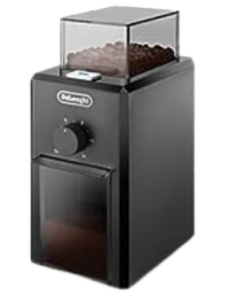
Another long-standing player in the budget grinder market, the De’Longhi KG79 shares remarkable similarities with the Krups model we just discussed. Our side-by-side comparison reveals a more compact footprint and lighter weight, plus a smaller bean capacity at 110g. The grinding mechanism appears virtually identical, using the same style of grinding wheels rather than traditional burrs.
Let’s address the elephant in the room – this grinder’s marketing as a “professional” model. As coffee industry veterans, we must be crystal clear: this isn’t a professional-grade grinder. Commercial machines used in cafés cost thousands of pounds and offer vastly different capabilities. While this budget-friendly option serves its purpose, setting realistic expectations is crucial.
In our extensive testing, we found the KG79 performs similarly to blade grinders but offers slightly better control over grind size. Unlike blade grinders that rely solely on timing, you can adjust the distance between the grinding wheels to influence particle size.
Customer feedback often splits into two camps: those praising its versatility from espresso to cafetière, and others noting its limitations with espresso grinding. This division typically stems from the type of portafilter basket being used – pressurised versus unpressurised.
Having thoroughly tested all three grinders in this category, we’ve found their performance remarkably similar, particularly regarding grind consistency. Our analysis shows a notable spread of particle sizes, producing both fine dust and larger fragments – a common trait of grinders using these basic grinding wheels.
The grinding speed is certainly brisk, which does generate some heat transfer to the beans. However, considering its price point, this grinder delivers performance on par with its competitors in the same bracket. Just remember to keep your expectations aligned with its budget-friendly status.
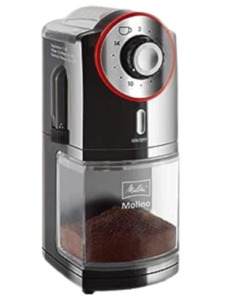
The Melitta Molino has carved out its place in the market alongside the Krups and De’Longhi models we’ve discussed. Our testing shows it uses similar grinding wheel technology, making it another budget-conscious option for coffee enthusiasts who aren’t quite ready to stretch their budget by £20-£30 for a grinder with traditional burrs.
The Melitta Molino has carved out its place in the market alongside the Krups and De’Longhi models we’ve discussed. Our testing shows it uses similar grinding wheel technology, making it another budget-conscious option for coffee enthusiasts who aren’t quite ready to stretch their budget by £20-£30 for a grinder with traditional burrs.
Now we’re stepping up to proper burr grinders, typically starting around £50-£60.
A crucial note from our testing experience: while these budget burr grinders work brilliantly with pressurised (dual-walled) baskets, most won’t meet the demands of traditional espresso baskets. They often can’t achieve the necessary fineness, and their adjustment steps aren’t precise enough for proper espresso dialling.
We’ll clearly indicate each grinder’s espresso capabilities in our detailed observations.
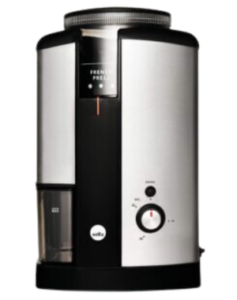
The Wilfa Svart (pronunciation quirks aside) has earned its popularity in this price bracket, particularly for filter coffee brewing methods.
Its innovative design caught our attention immediately. Unlike conventional grinders, the hopper integrates seamlessly into the body rather than protruding from the top. Both the hopper and grounds container feature UV filtration – a thoughtful touch that helps preserve bean freshness.
During our comparative testing, we found the grind quality similar to other 40mm conical burr grinders in this range. However, the Svart’s superior build quality stands out distinctly. The noise levels are noticeably lower than budget competitors, and the robust construction suggests better longevity.
While it might cost £40-£50 more than generic alternatives, our extensive testing suggests this investment pays off. The impressive 5-year manufacturer’s warranty provides excellent peace of mind – a rare find in this price bracket.
The grind adjustment mechanism is wonderfully intuitive – simply rotate the hopper, which features helpful brewing method indicators on its surface. However, we must note that this isn’t your grinder if you’re planning to use unpressurised espresso baskets. For that, we’d direct you to the Gaggia MD15 discussed below.
Looking for an upgraded version? Check out the Aroma Precision model we cover next.
Remember: even the finest grinder can’t compensate for poor quality beans. We recommend starting with high-quality coffee beans to get the most from your grinder.
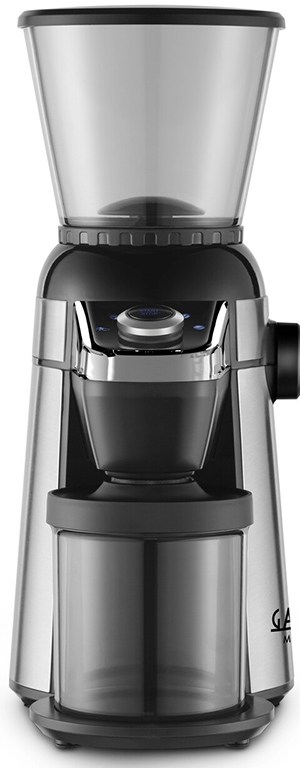
Gaggia specifically developed the MD15 conical burr grinder to complement their entry-level espresso machines – the Gran Gaggia, Carezza, and Viva. It’s also compatible with the Gaggia Classic Pro when using pressurised baskets (though the Classic Pro includes both standard and pressurised options). Keep reading for our findings about the shim modification for traditional baskets.
Important Update: Now includes shims as standard for finer grinding capability! Details below.
Looking back at Gaggia’s grinder history provides interesting context. Their previous model, the Gaggia MDF, was something of an oddity – a domestic grinder featuring a commercial-style doser chamber. For those unfamiliar with dosers, they’re the spring-loaded levers you’ll spot baristas rapidly flicking in cafés to dispense pre-ground coffee. While efficient in high-volume settings, these dosers proved impractical for home use.
Many coffee enthusiasts pairing their Gaggia Classic with a grinder often avoided the MDF solely because of this doser mechanism. When we heard about Gaggia developing a new doserless grinder, our team anticipated something that might rival the sophisticated features of Sage, Baratza, or Eureka models – essentially, an MDF successor with modern on-demand grinding.
However, Gaggia took a different approach with the MD15. They’ve positioned it as a companion piece for their entry-level machines, including the Gran, Viva, and Carezza, along with other cheaper espresso machines using pressurised baskets.
During our testing, we discovered something quite remarkable about the MD15: it’s wonderfully simple to modify for traditional espresso grinding. The modification process is straightforward – remove the hopper, twist out the outer burr, and you’ll find just two screws securing the burr to its holder.
Originally, achieving espresso-fine grounds simply required placing a thin spacer (made from card or plastic) between the burr and its holder. This small adjustment brings the burrs closer together, enabling proper espresso grinding with unpressurised baskets – at nearly half the cost of typical espresso-capable grinders.
Here’s where it gets even better: Gaggia Direct has made this process practically foolproof. They now include purpose-made shims with every MD15, complete with installation instructions. In our extensive testing, we’ve found that using two shims typically produces optimal results. The entire modification takes about two minutes – just remove two screws, add the shims, and reassemble. This makes the MD15 the most affordable grinder capable of true espresso grinding, albeit with a minor DIY adjustment.
Important note: If you’re not planning to make espresso with traditional baskets, there’s no need to install the shims.
Beyond its modification potential, we’ve found the MD15 quite impressive in daily use. The aesthetic design is pleasingly modern, and operation couldn’t be simpler. The intuitive dosing system uses coffee bean icons to indicate volume settings, with a portafilter icon for continuous grinding. In our workshop testing, we noted the noise levels were quite reasonable compared to competitors in this price range.
Let’s talk about the MD15’s espresso capabilities in detail. Straight out of the box, without shims installed, this grinder isn’t designed for traditional unpressurised basket espresso. Typically, you’d need to spend significantly more for that capability.
However, the inclusion of free shims from Gaggia Direct has changed the game entirely. The simple modification effectively transforms this into an espresso-capable grinder – though with a notable caveat: the adjustment steps.
Our testing revealed both strengths and limitations. With 15 grinding steps, we found the adjustment intervals slightly too large for precise espresso dialling. While we consistently achieved what we call “ballpark dialling in” (getting close to ideal extraction), the step size prevents the fine-tuning you’d get with stepless adjustment or grinders offering smaller incremental steps.
Exciting Bundle Alert: Gaggia Direct currently offers an impressive package deal. You can get either the Gran Gaggia or Gaggia Viva, bundled with the MD15 (shims included) and your choice of standard or naked portafilter. Prices start from just £248 for the complete setup!
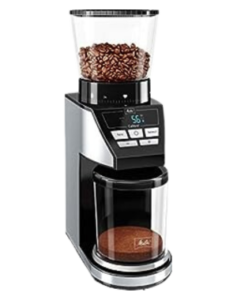
While the Calibra might be relatively new to the grinder market, Melitta’s coffee heritage runs deep. In fact, they’re responsible for one of the most significant innovations in coffee history – they invented filter coffee!
The story begins in 1908 when Melitta Bentz set out to create a cleaner cup of coffee. Her experiments led to a groundbreaking invention: the world’s first filter holder and drip filter for coffee. This revolutionary development forever changed how we brew coffee.
The Melitta Calibra stands out in the budget grinder market by offering something quite special – it’s currently the most affordable grinder with built-in weight-based dosing (GBW). During our testing, we found the scales accurate within about a gram, which, while not laboratory-precise, proves more than adequate for most home brewing needs. To put this in perspective, being off by a gram when measuring a 30-gram dose won’t significantly impact your final brew.
One limitation worth noting: you can’t use the scales when grinding directly into a portafilter. However, considering even the Baratza Forte (priced at roughly nine times more) shares this limitation, we can hardly mark down the Calibra for this. After all, this grinder primarily targets filter coffee enthusiasts, and for that purpose – whether brewing with filter, AeroPress, or cafetière – it performs admirably.
Speaking of espresso, our testing confirmed this isn’t your grinder for traditional unpressurised baskets. Even with dark roasts (which typically require a coarser grind), we couldn’t achieve acceptable shot times on the finest setting. However, it works perfectly well with pressurised baskets.
Several thoughtful design features impressed us during daily use. The hopper removal system proves particularly clever – one button press releases it while automatically sealing the beans inside, preventing any spillage. The grind adjustment mechanism feels intuitive, and the noise levels remain reasonable for this price point.
When evaluating value for money, we noticed Melitta has prioritised features over build quality. If you’re seeking a straightforward, durable grinder without bells and whistles, the Wilfa Svart or Wilfa Svart Precision might better serve your needs – both backing their build quality with impressive 5-year warranties.
However, if you’re specifically looking for an affordable filter coffee grinder with integrated scales, the Calibra currently offers unbeatable value. While it may not match the tank-like construction of some competitors, it delivers a pleasant user experience with features typically found on much pricier models.
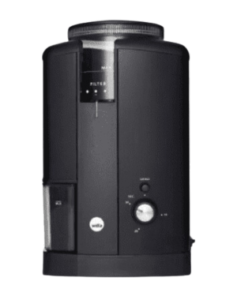
The Aroma Precision represents Wilfa’s evolution of their popular Svart model. The main technical upgrade centres on its motor – now running at lower speeds and temperatures, theoretically preserving more flavour compounds during grinding.
During our comparative testing, we noted two immediately apparent differences: the Precision runs noticeably quieter than its predecessor, and it sports a rather fetching matte black finish that, in our opinion, gives it a more premium appearance.
However, let’s address the elephant in the room – the marketing claims about flavour enhancement through reduced grinding temperature. Based on our extensive blind taste testing, we need to be frank: while heat can indeed affect coffee flavour, the temperature difference between these motors produces such minimal impact that even our most experienced team members struggled to detect any meaningful variation in cup quality.
For most coffee enthusiasts, the real-world benefits of the Precision model come down to its reduced noise levels and aesthetic upgrade rather than any revolutionary taste enhancement. While there’s nothing wrong with choosing this model – it’s an excellent grinder in its own right – we believe it’s important to set realistic expectations about the practical differences between the two versions.
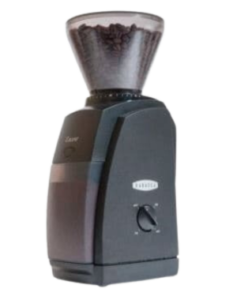
The Baratza Encore has earned its reputation as one of the most trusted entry-level grinders, particularly excelling at manual brewing methods and pressurised-basket espresso. While it’s worth noting that Baratza operates under Breville’s ownership (known as Sage in the UK), they maintain completely independent operations.
The technical specifications tell an interesting story. The 40mm conical steel burrs are powered by a DC motor that’s geared down to 450 RPM, specifically engineered to minimise heat generation, static buildup, and noise levels.
In our durability testing, we were particularly impressed with the second-generation gearbox improvements. Baratza’s own stress tests demonstrate remarkable resilience – they actually attempted grinding metal screws to verify the failsafe mechanism. The result? Instant shutdown with thermal cutout activation, leaving both gears and motor unscathed.
A practical note: while we certainly don’t recommend grinding any foreign objects, if you do encounter a stray stone (or an unexpected diamond – in which case, congratulations on your windfall!), the grinder should survive. Just remember to inspect the burrs for damage afterwards.
The 40 grind settings offer excellent range for most brewing methods. However, we must be clear about espresso capability: our testing confirms this won’t achieve the fineness required for unpressurised baskets. For budget espresso machines with pressurised baskets – like the Swan Retro, Gran Gaggia, or DeLonghi Dedica EC685 – you’ll find it perfectly suitable.
In our assessment, the Encore represents top-tier quality among grinders focused on brew methods and pressurised-basket espresso. While it sits at the higher end of the price spectrum for this category, our extensive testing suggests the build quality and performance justify the investment.
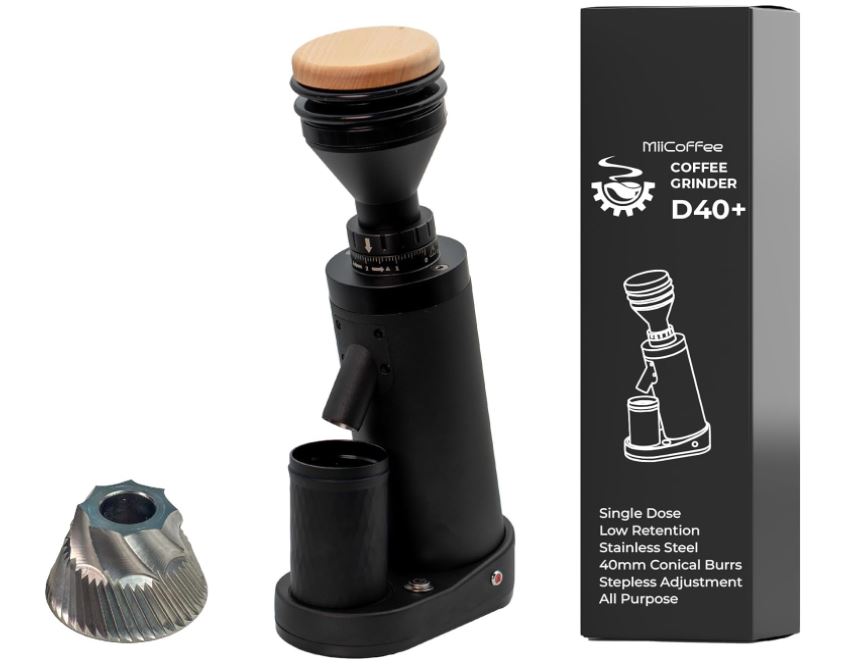
Meet the compact sibling of the widely acclaimed DF64 and DF83 single-dose grinders. While we can’t confirm shared manufacturing origins, this grinder shares distributors with the DF series and, more importantly, delivers similarly impressive performance-to-cost ratio.
Our detailed testing revealed several standout features. The stainless steel 40mm conical burrs achieve remarkably fine grinding capability, housed in an all-metal construction that keeps operational noise surprisingly low. For the price point, we’re genuinely impressed with the overall package.
Regarding the adjustment mechanism: while marketed as stepless, our testing detected subtle clicks during adjustment. These gentle detents don’t significantly impact precision – you can technically position between clicks – though in practice, we found the grinder tends to settle into the nearest click position during operation, similar to other stepped grinders.
The single-dose design incorporates a bellows hopper for minimising retention. It’s worth noting this differs from true zero-retention designs like the Niche Zero, which achieves this through fundamental engineering. Without using the bellows, retention levels match typical grinders like the Sage series. However, a few pumps of the bellows effectively clears retained grounds.
Additional quality touches include a premium metal dosing cup with magnetic attachment and a compact footprint that won’t dominate your counter space. For dedicated espresso use under £200, this grinder ranks high on our recommendation list.
However, for those seeking versatility, we still favour the Smart Grinder Pro as the superior all-rounder at this price point, offering reliable performance across all brewing methods from espresso to cafetière.
A few minor quibbles: the faux wood plastic lid feels somewhat out of place on an otherwise premium-feeling machine, and the power button occasionally requires a second press to register. These are minor concerns given the price point.
Important Purchase Note: When buying directly from MiiCoffee rather than Amazon, factor in delivery costs and potential import duties, which can significantly impact the final price.
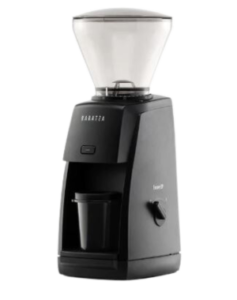
Baratza has brilliantly addressed the original Encore’s espresso limitations with this specialist version. While the standard Encore earned its reputation as a reliable entry-level grinder, its relatively wide adjustment steps and grind range weren’t ideal for traditional espresso baskets.
The ESP’s ingenious solution lies in its asymmetrical adjustment mechanism. During our testing, we discovered how the first 20 settings offer remarkably precise control within the espresso range. The engineering behind this is clever yet simple: Baratza implemented a steeper thread pitch for settings 20-40, creating significantly finer adjustments in the crucial espresso zone.
Our hands-on experience revealed several thoughtful design features. The included dosing cup comes with an adaptable gasket system, easily accommodating both 53/54mm and 58mm portafilters. While it ships with a standard hopper, Baratza offers an optional single-dose attachment for those preferring that workflow.
The ESP stands out in the competitive entry-level espresso grinder market, particularly challenging established players like Sage. (Though given Breville’s 2020 acquisition of Baratza for approximately $60 million, this friendly competition stays within the corporate family.)
Based on our extensive testing, we’d strongly recommend considering the Encore ESP if you’re shopping in the £200 range specifically for espresso grinding. Its precise adjustment capabilities, coupled with Baratza’s reputation for reliability, make it a compelling choice in this category.
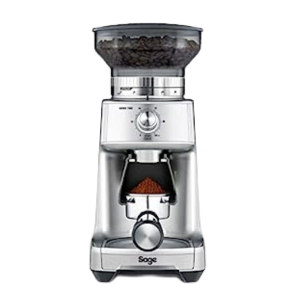
Meet the streamlined sibling of the Smart Grinder Pro. This model strips away the digital interface while maintaining core grinding capabilities, offering a more budget-friendly entry point to Sage’s grinder line.
In our comprehensive testing programme, this stands out as the first grinder in our price-ascending review capable of proper espresso grinding with unpressurised baskets. Beyond espresso, it proves remarkably versatile, handling everything from cafetière to pour-over with impressive consistency.
Comparing it with its premium sibling, the Smart Grinder Pro, reveals some notable differences. The Dose Control Pro features a slightly less powerful motor (130W versus 165W) and forgoes the LCD screen and electronic adjustment dial in favour of traditional hopper adjustment. The hopper capacity also differs, holding 240g compared to the Smart Grinder Pro’s 450g.
While not specifically designed as an espresso specialist, our testing confirms this as possibly the most affordable grinder capable of achieving proper espresso fineness with traditional baskets. The stepped adjustment mechanism, while simpler than stepless alternatives, offers practical advantages for home users.
We particularly appreciate the ability to quickly switch between brewing methods. For instance, when you’ve dialled in your perfect espresso setting, you can easily jump to a coarser setting for filter coffee and return precisely to your espresso setting afterwards. This versatility contrasts with dedicated espresso grinders, which typically feature stepless adjustment – excellent for fine-tuning espresso but less practical for switching between brewing methods.
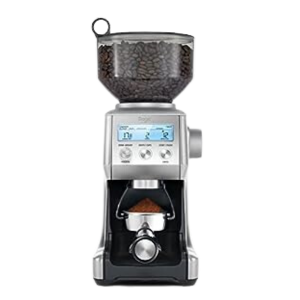
After six years of intensive testing and daily use, we can confidently say this grinder delivers exceptional value. For those seeking a versatile grinder capable of handling both traditional basket espresso and other brewing methods, it stands as one of the strongest contenders in its price bracket.
When it comes to user-friendliness, particularly for beginners, the Smart Grinder Pro sets a high bar at this price point. Its ability to seamlessly transition between brewing methods while maintaining consistent settings proves invaluable in daily use.
Sage (known as Breville outside Europe due to a 1980s brand name sale) demonstrates their technical prowess through thoughtful design features. The LCD display clearly indicates grind size and corresponding brewing method ranges, while the 60 available settings offer precise control. The inclusion of both a portafilter cradle and grounds container enhances its versatility.
Earlier models faced criticism regarding impeller wear, but our long-term testing confirms this issue was resolved years ago with improved materials. Our test unit has processed countless kilos of coffee without any impeller problems, proving remarkably robust even with minimal maintenance.
The user interface deserves special mention – it’s remarkably intuitive. The grinder achieves sufficient fineness for proper espresso while handling coarser grinds for cafetière, AeroPress, and pour-over with equal competence.
Our extended testing reveals few significant drawbacks. The grinder’s durability has impressed us – even with less-than-perfect maintenance routines, it continues to perform reliably. Its combination of user-friendly features and consistent performance makes it a standout choice for home baristas seeking versatility without complexity.
Moving beyond entry-level options, let’s explore what we consider mid-range and above grinders, starting with a particularly impressive offering.
Moving beyond entry-level options, let’s explore what we consider mid-range and above grinders, starting with a particularly impressive offering.

The DF54 essentially reimagines its popular bigger sibling, the second-generation DF64, in a more compact 54mm format. Our testing reveals remarkable value for money – though we should note that the advertised MiiCoffee price doesn’t include delivery costs or import charges. Even factoring in these additional costs (typically bringing the UK price to around £250), this grinder offers exceptional performance for its price point.
In terms of retention, our testing places this among what we consider “true” zero-retention grinders. While absolutely zero retention remains theoretically impossible, our measurements show impressively low numbers: initial retention of about 0.3g on first use, dropping to 0.2g on the second grind, then stabilising at approximately 0.1g for subsequent grinds – all without using the bellows.
This performance stems from clever engineering, particularly the built-in ionizer and thoughtfully designed chute. These features not only minimise retention but also create a remarkably uniform, controlled flow of ground coffee. During our extensive testing, we observed consistently neat, even distribution patterns.
The anti-popcorning device proves particularly effective at managing the common single-dosing challenge where the final few beans tend to bounce out of the burrs (a phenomenon coffee enthusiasts have amusingly dubbed “popcorning”).
In essence, our testing confirms the DF54 delivers professional-grade single-dosing capabilities with near-zero retention at a remarkably competitive price point.
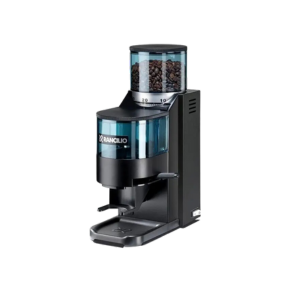
The Rancilio Rocky occupies an interesting position in today’s market. While some might consider it overshadowed by newer options, our analysis suggests it’s actually underappreciated – particularly as the most affordable genuine flat burr grinder available.
Once a staple pairing with the Rancilio Silvia, the Rocky has faced intense competition from newer entry-level options. However, our testing reveals compelling value: it’s currently about £120 less than the Eureka Mignon Manuale, making it the most affordable path into flat burr grinding.
The build quality immediately impressed our team. This grinder feels more like a scaled-down commercial unit than a domestic appliance, featuring robust construction and high-quality 50mm tempered steel flat burrs. While it lacks fancy features, Rancilio has clearly invested in core components and structural integrity – a refreshing approach in today’s feature-heavy market.
However, our testing revealed one ergonomic challenge: the adjustment mechanism demands considerable dexterity. Following best practices (adjusting while grinding, particularly when going finer), you’ll need to simultaneously:
For single-dosing users, this becomes less problematic – you can likely adjust without running the grinder, simplifying the process considerably.
Despite this quirk, the Rocky’s solid engineering and flat burr design at this price point make it worthy of serious consideration, especially for those prioritising grind quality over convenience features.
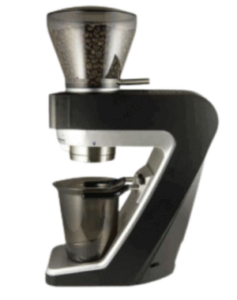
For those considering grinders in the entry-to-mid price range, particularly for espresso and pour-over brewing, the Sette 270 deserves serious attention. If you’ve encountered dated criticisms of this model, our recent testing reveals significant improvements worth considering.
The Sette 270 requires a fresh evaluation, as Baratza has implemented substantial engineering changes that many coffee enthusiasts may not realise. While it maintains its position alongside the Eureka Mignon as a leading entry/mid-level choice, the latest iteration brings notable improvements.
Most revolutionary is the dual adjustment system: 30 macro steps for broad changes, complemented by stepless micro-adjustment for espresso fine-tuning. In our testing, this proved brilliantly practical – we’re actually surprised other manufacturers haven’t adopted similar systems, given how effectively it bridges the gap between brew methods.
The redesigned drive system marks another significant advancement. Rather than spinning the central conical burr, it rotates the outer ring burr. Our testing confirms this creates a more direct grinding path, reducing retention to approximately one gram – a substantial improvement.
Understanding retention’s importance: “Exchanged retention” refers to grounds that remain in the grinder, mixing with your next batch. This becomes particularly relevant for the first brew of the day or after grind adjustments, typically requiring purging to avoid stale or mixed-size grounds.
While the Niche Zero (which we’ll discuss later) revolutionised the market with near-zero retention, this updated Sette achieves remarkably similar results. Our measurements show retention levels approaching those of dedicated single-dose grinders – quite an achievement for a hopper-based design.
However, we should note the grind range limitations. With a range of 230–950 μm, it excels at finer grinds. Our testing shows excellent results for espresso and small-batch pour-over brewing (Kalita Wave, Hario V60, Chemex), but those needing coarser grinds for cafetière or large-batch brewing might find the range slightly restrictive.
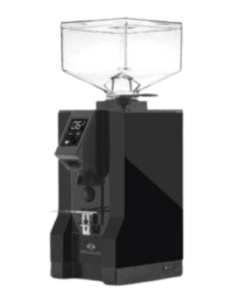
Within the impressive Eureka Mignon range, spanning from the entry-level Crono (£200+) to the premium XL (£700+), the Specialita emerges as our top pick. After extensive testing with various espresso machines, its performance consistently impresses.
The grinder combines compact design with tank-like build quality. Our long-term testing reveals outstanding durability, whisper-quiet operation, precise stepless adjustment, and remarkably clean grinding. The dual programmable dose settings prove particularly convenient for daily use.
Speaking of durability, we can attest to its robust construction through an unexpected stress test. When a copper fragment accidentally found its way into our coffee beans (twice!), the grinder’s safety system performed flawlessly. It simply stopped, preventing any damage to the burrs or motor.
This incident highlights an important aspect of grinder design: foreign object protection. While stones in coffee beans occur more commonly than copper, manufacturers handle this challenge differently. Eureka’s approach proves highly effective, though it differs from others like Sage’s Smart Grinder Pro, which uses a clutch system similar to cordless drills.
The clutch system works well but can occasionally misinterpret very hard, light-roasted beans as foreign objects – a challenge that premium manufacturers like Eureka and Niche address differently with their protection systems. This becomes particularly relevant when you consider that grinders without proper safety mechanisms risk gear damage when encountering unusually hard objects.
Our extensive testing revealed only one minor drawback: the adjustment dial’s numbering system. While the stepless adjustment offers infinite precision (numbered 0-5 with half-step increments), tracking becomes tricky beyond one full revolution when grinding for non-espresso methods. You might find yourself at “0” again without clear indication of total rotations.
For a detailed comparison of other models in the range, see:
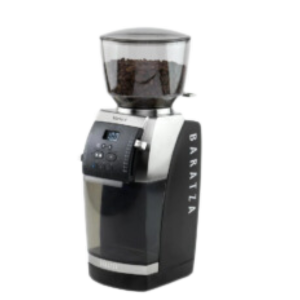
The Vario+ presents an intriguing proposition, particularly when compared to its similarly-priced sibling, the Sette 270 Wi. While sharing a price point, these grinders offer distinctly different specialities.
In our analysis, the Vario+ essentially brings the capabilities of its premium sibling, the Forte, to a more accessible price point. It shares the same impressive 54mm ceramic burrs and extensive grinding range (230 to 1150 microns), making it remarkably versatile across brewing methods.
The grind adjustment system particularly impressed us during testing. While not quite matching the Forte’s precision, the Vario+ offers an impressive 200 distinct settings through its macro/micro adjustment system (10 macro settings, each with 20 micro adjustments). This provides exceptional control for dialling in your perfect grind, whether for espresso or filter coffee.
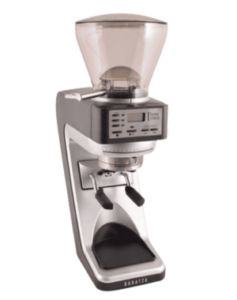
Building on the standard Sette 270 platform, this model integrates sophisticated Acaia weighing technology. This advancement transforms the grinding process from time-based to weight-based dosing, offering unprecedented precision through built-in scales.
The Wi represents Baratza’s refined approach to weight-based grinding, addressing several limitations of its predecessor, the 270W. Our testing reveals significant improvements in real-world usability.
A standout enhancement tackles the previous model’s sensitivity to surface stability. The new design incorporates adjustable cradles for both portafilter and grounds container, effectively compensating for uneven surfaces. This might seem like a minor detail, but our testing shows it makes a substantial difference in daily use.
Perhaps most impressive is the Wi’s intelligent offset compensation system. During our testing, we observed how the grinder learns from slight variations – for instance, if you set a 21g dose but consistently receive 21.2g, the system gradually self-adjusts over several shots to achieve greater accuracy. This adaptive technology demonstrates Baratza’s commitment to user feedback and continuous improvement.
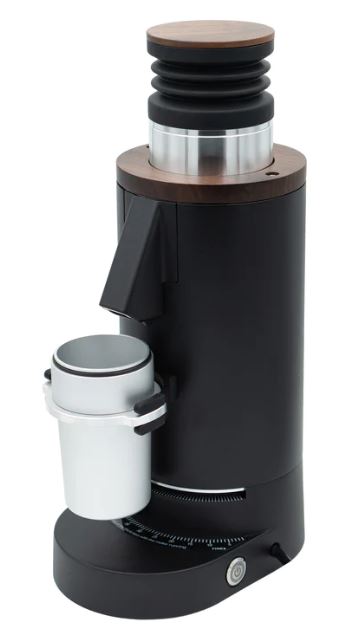
The DF64 emerged as the first serious challenger to the Niche Zero’s dominance in the single-dose market. Our extensive testing reveals why it’s gained such popularity among home baristas.
The range has expanded to include several variants. The DF64P featured here specialises in espresso, while the DF64 II offers broader versatility across brewing methods. The premium DF64V version introduces variable RPM control and DLC (diamond-like carbon) coated burrs in a refined design. Budget-conscious buyers should explore Miicoffee Open Box options.
Regarding the 64mm flat burrs – while this size has become something of a standard in mid-range grinders, our blind taste testing challenges some common assumptions. After comparing various flat burr sizes from 55mm to 83mm using identical espresso machines, we’ve found the correlation between burr size and cup quality less straightforward than often suggested.
However, the DF64’s value proposition extends well beyond burr specifications. Our testing reveals impressive performance-to-cost ratio, with several standout features:
Unlike the D40+ discussed earlier, this grinder achieves excellent results as a single-doser even without the bellows attachment. The retention levels remain low enough to eliminate the need for purging between doses, making the bellows optional rather than essential for optimal performance.
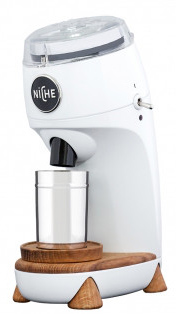
The Niche Zero revolutionised home coffee grinding. While its unconventional design initially raised eyebrows among traditional manufacturers, its impact on the market proves transformative. Our extensive testing reveals why this unusual-looking device has become perhaps the most influential home coffee grinder ever created.
The success story begins with designer Martin Nicholson’s unique perspective. His extensive product design experience, coupled with relative unfamiliarity with coffee grinder conventions, proved advantageous. Rather than simply scaling down commercial designs (the industry standard), Nicholson approached the challenge from a home user’s perspective.
The result? A grinder that excels in both form and function, looking perfectly at home in modern kitchens while delivering commercial-grade performance through its 63mm Mazzer Kony burrs.
Our testing confirms the Niche Zero precisely addresses core home barista needs:
What particularly impresses us is the grinder’s holistic excellence. Rather than excelling in just one area – be it retention, aesthetics, or performance – it achieves remarkable results across all metrics.
The only initial limitation we identified involved “popcorning” – the tendency for beans to bounce around when grinding small quantities. However, Niche quickly addressed this with an anti-popcorning plate. In our testing, this works effectively, though we found it can slightly slow larger doses. For brewing methods requiring 40g or more (like cafetière), we recommend removing the plate.
For espresso enthusiasts, we’ve found it pairs exceptionally well with prosumer machines like the Sage Dual Boiler.
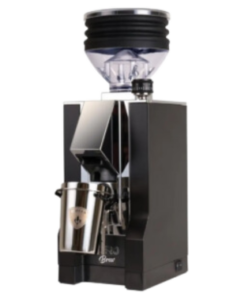
Eureka’s latest addition to their “Zero” line presents an intriguing value proposition. While their Oro Zero (which we’ll discuss below) adapts the Mignon XL’s larger “diamond inside” burrs for single dosing, this model reimagines the popular Specialita for zero-retention grinding. At its competitive price point, it offers an compelling alternative to the Niche Zero.
Our comparative testing reveals some important distinctions. While the Mignon Zero may not quite match the Niche Zero’s grinding performance (understandable given the Niche’s premium 63mm Mazzer Kony burrs), it offers significant value. For those finding the Niche’s £499 price tag stretching their budget, the Mignon Zero typically available around £420-£430 represents an attractive compromise.
Essentially, this grinder delivers the Specialita’s proven performance in a single-dose format, complete with dedicated hopper and bellows system. Our testing suggests it hits a sweet spot between performance and accessibility in the growing single-dose market.
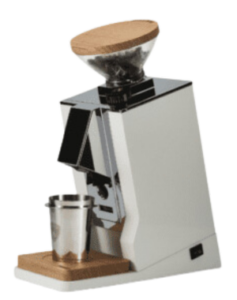
The Mignon Oro emerges as the first serious challenger to the Niche Zero’s dominance in the premium single-dosing market.
Eureka’s entry into this space makes strategic sense. With Niche’s direct-to-consumer model leaving retailers unable to access this lucrative market segment, established manufacturers with strong distribution networks stood to gain by developing competitive alternatives.
The Oro essentially reimagines their Mignon XL, incorporating its premium 65mm diamond-inside flat burrs and impressive grinding speed. Our technical analysis reveals clever engineering – they’ve angled the grinding mechanism to create a more direct, gravity-assisted path, complemented by bellows for minimal retention.
Speed emerges as a key differentiator. Our testing shows the Oro achieving 2.3-2.8g per second for espresso grinding, significantly outpacing the Niche Zero’s 1.5-1.8g per second. While speed might not top most home users’ priority lists (the Niche deliberately prioritises torque over speed through motor gearing), it could appeal to efficiency-focused users.
However, we notice one puzzling design choice: the omission of the Mignon XL’s touch screen programmable dosing. While this might align with minimalist single-dosing aesthetics, it potentially misses an opportunity. Some users, particularly during busy mornings, might prefer automated dosing options rather than standing by for 10-15 seconds of manual operation.
This decision seems driven by a desire to match the Niche’s minimalist approach rather than leveraging existing technology. Our view? Retaining programmable dosing could have carved out a distinct market niche, appealing to users seeking both single-dosing capability and convenience features.
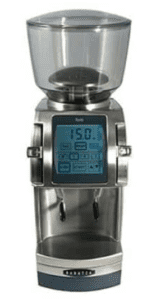
The Baratza Forte has earned its reputation as one of the most sophisticated grinders available to home baristas, excelling at both espresso and brew grinding. Like the Sette 270 Wi, it features integrated scales for weight-based dosing, but takes precision to another level with its remarkable 260 distinct settings spanning 230 to 1150 microns.
Our testing confirms its commercial-grade capabilities across several key areas:
However, what particularly impressed us during extended testing was the unprecedented grinding precision. The combination of 10 macro steps, each with 26 alphabetically-marked micro-adjustments (A-Z), offers unparalleled control over particle size. This level of fine-tuning transforms the often frustrating process of dialling in espresso into a methodical, precise operation.
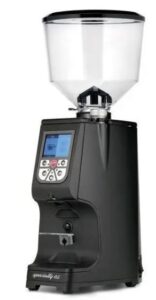
While primarily designed for commercial environments, our testing reveals the Atom Specialty 65 as a compelling option for serious home enthusiasts, particularly when paired with Eureka’s short bellow hoppers.
Performance highlights from our testing include:
While the investment level places this grinder beyond most home users’ requirements, those seeking commercial-grade capabilities in a home setting will find the Atom offers exceptional value within the commercial grinder category. Our testing suggests it successfully bridges the gap between professional and prosumer use, particularly with its adaptable hopper options.
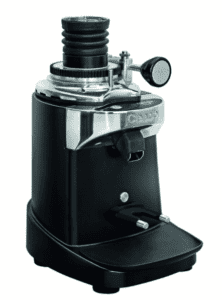
We’re including this grinder to illustrate the remarkable breadth of the market. At this significantly higher price point, it represents a different league of grinding technology, ideal for pairing with premium machines like the La Marzocco Linea Mini.
Our testing reveals several standout features:
This heavyweight contender (literally – at 13.2 Kg) requires some patience during the initial break-in period. Users should expect some inconsistency until the burrs properly season.
One notable design consideration involves bean feeding behaviour (popcorning). While this phenomenon – where the final few beans bounce rather than feed smoothly into the burrs – might seem surprising at this price point, our testing suggests minimal impact on cup quality. Nevertheless, a simple anti-popcorning plate (like those used by competitors) could easily address this.
The grinder’s most innovative feature is its hybrid adjustment system. It cleverly combines:
This solves a common limitation of worm drive systems – their impracticality for switching between brewing methods. Users can disengage the worm drive for major adjustments (similar to the Niche Zero’s system), then re-engage for fine-tuning.
While this grinder’s price point puts it beyond most home users’ consideration, it demonstrates the continuing evolution of single-dosing technology at the premium end of the market.
Our comprehensive review covers a broad spectrum of the UK coffee grinder market, from entry-level options to premium professional-grade equipment. While we acknowledge the significant price gap between the Forte and E37SD, this illustrates the remarkable diversity available to today’s coffee enthusiasts.
We’ve focused on the most relevant options for most home baristas, though the market extends far beyond what we’ve covered here. For those interested in exploring additional options across all price ranges, we recommend browsing the full selection at:
Remember: the perfect grinder depends on your specific needs, brewing methods, and budget. Whether you’re starting your coffee journey or upgrading your existing setup, we hope this guide helps you make an informed decision.
While we’ve reviewed many specific models above, the key distinction lies in the grinding mechanism. Burr grinders, particularly those with sharp flat or conical burrs, consistently outperform both blade grinders and basic “grinding wheel” models. While blade grinders offer advantages over pre-ground coffee, and grinding wheel models improve upon blade grinders, proper burr grinders deliver superior results.
Several manufacturers have established strong reputations:
In the commercial/prosumer sector, respected names include Mazzer, Mahlkonig, Victoria Arduino, Anfim, Ditting, and Cunill.
The rise of single dosing, popularised by the Niche Zero, suits different user profiles differently:
Consider single dosing if you:
Traditional hopper grinders might suit you better if:
Even with hopper grinders, we recommend against storing beans in the hopper. Instead, use an airtight container and add only what you’ll use that day.
Your basket type determines grinder requirements:
Essential features for traditional baskets:
For more guidance on complete setups, see:
Our recommendation: Prioritise the grinder.
While many beginners focus 60-70% of their budget on the espresso machine, we suggest inverting this ratio. Here’s why:
As one commercial espresso engineer notably stated: “The espresso machine is essentially a water heater – it’s the grinder that determines quality.” While this oversimplifies matters, it emphasizes a crucial point: investing in grinding quality typically offers better returns than equivalent spending on machine features.
Caffeinatedgear.com is a participant in the Amazon Services LLC Associates Program, an affiliate advertising program designed to provide a means for sites to earn advertising fees by advertising and linking to amazon.co.uk.
© 2025 Caffeinated Gear.