

By: The Caffeinated Gear Team
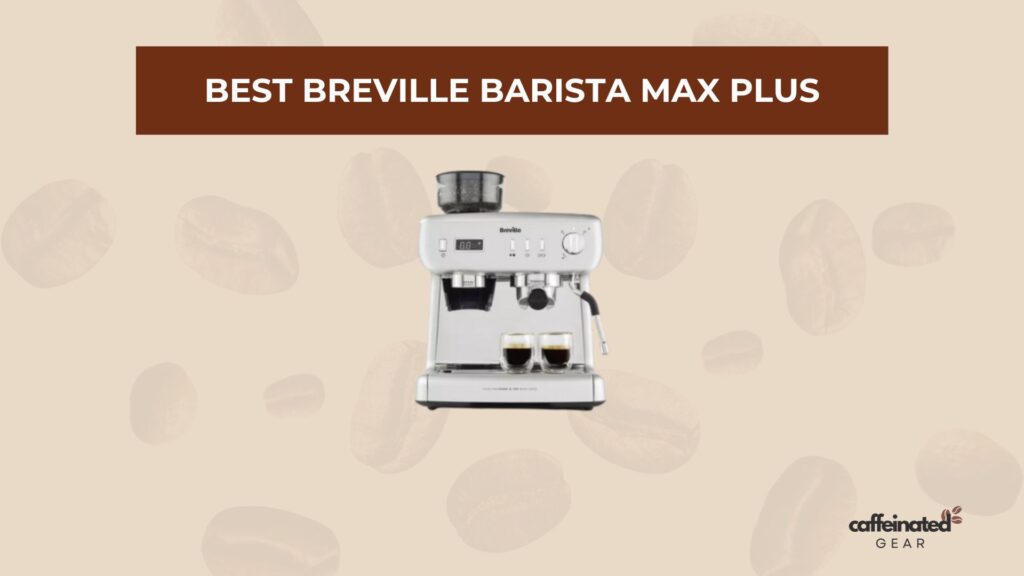
Our team of coffee experts has spent countless hours putting the Breville Barista Max Plus through its paces, and we’re ready to share our comprehensive findings.
We’ve noticed a growing trend of coffee enthusiasts confusing this machine with the Barista Express or Barista Pro, particularly due to their price points.
This hands-on review will clear up any confusion and provide our unvarnished assessment of whether this more budget-friendly option deserves a spot on your kitchen counter.
After thoroughly testing this machine in our coffee lab, we’re bringing you genuine insights based on real-world experience rather than manufacturer specifications.
Here’s something that often puzzles coffee enthusiasts: while Breville and Sage might share similar designs, they’re distinct entities in the UK market.
Let us break this down for you:
The original Breville Group, based in Australia, has built a stellar reputation for their coffee machines worldwide. They’re a publicly traded company with impressive global reach and an outstanding line of coffee equipment.
However, there’s an interesting twist in the European market. Due to a 1980s business decision, the Breville name in Europe was sold off. This created an unusual situation where the original Breville company needed a different identity for the European market.
Enter Sage Appliances – the brand name under which these machines are sold in the UK.
Curious about the connection between Breville coffee machines in the UK versus Australia? We’ve got the full story.
Newell Brands, an American corporation that owns popular brands like Yankee Candle and Mr. Coffee, holds the rights to the Breville name in the UK.
They’re also the proud owners of Sunbeam, a significant player in the Australian coffee machine market.
In Australia, Sunbeam offers coffee machines that share remarkable similarities with Breville models in design, features, and even naming conventions.
Many coffee enthusiasts note the price difference between these brands in Australia, though we’ll let you draw your own conclusions about their market positioning.
From a business perspective, it makes perfect sense for Newell Brands to market their Sunbeam machines under the Breville name in the UK, taking full advantage of their brand ownership.
Our team regularly encounters confusion among coffee enthusiasts about this branding situation, particularly in today’s interconnected digital world.
Before the internet revolutionised how we research products, consumers relied on local shops, magazines, and television for product information.
Now, when you research coffee machines online, you’ll find information from every corner of the globe. While Google cleverly filters shopping results based on your location, informational searches often lead to worldwide results.
This worldwide access can create confusion. You might discover countless positive reviews about Breville espresso machines on international forums and Reddit threads. However, when you search for “Breville Barista espresso machine” in the UK, you’ll find yourself on the Currys website – currently the exclusive UK retailer for Breville espresso machines.
This is where things get tricky. The espresso machines you’ll find share similar names with Sage’s Barista Express and Barista Pro, leading some shoppers to mistake them for the same product at a lower price point.
This misunderstanding has unfortunately led to some negative reviews from disappointed customers who expected to receive Sage-equivalent machines.
However, putting aside this brand confusion, our thorough testing of the Breville Barista Max + reveals it’s quite an impressive machine when judged on its own merits and price point.
Now that we’ve cleared up any potential confusion about branding, let’s dive into our review of the Breville Barista range.
The lineup includes three Barista Max models, plus the Barista Mini, which bears a striking resemblance to the Sage Duo Temp Pro. While we’ll focus primarily on the Barista Max +, here’s a quick overview of the full range:
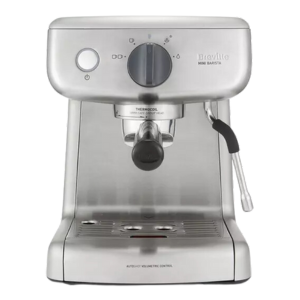
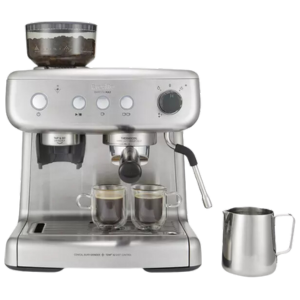
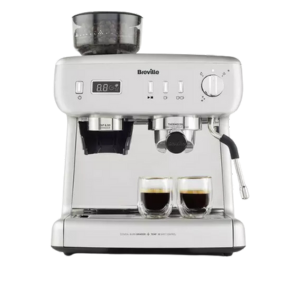
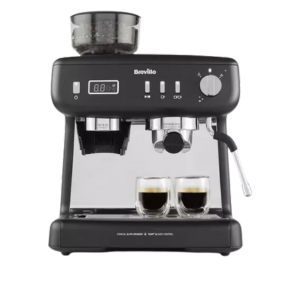
For comparison, here are the Sage models mentioned earlier:
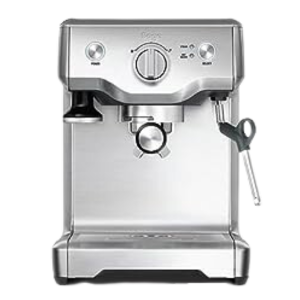
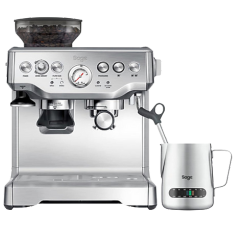
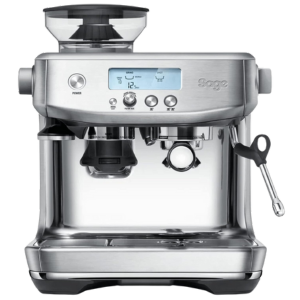
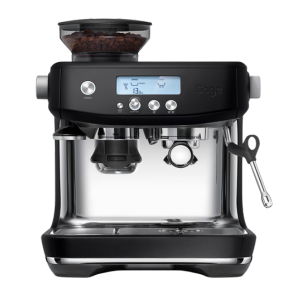
At current prices on Amazon, the price differences are significant:
For detailed information about the Sage machines, check out our comprehensive reviews:
We’ve purchased and extensively tested the Breville Barista Max Plus, which will be the main focus of this review. While we’ll cover the entire range, we believe the Max Plus offers the most compelling features for its price point, making it particularly interesting to potential buyers.
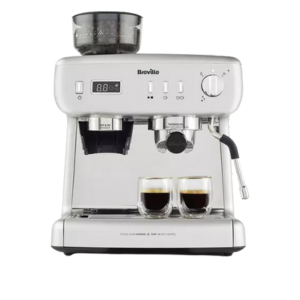
After extensive testing in our coffee lab, we’re genuinely impressed with the Breville Barista Max+. At this price point, it’s a remarkable achievement that combines solid build quality with impressive functionality. Our team of baristas put this machine through its paces, and the results were genuinely surprising.
Let’s be crystal clear though – while this machine offers fantastic value, it’s important to understand what you’re getting. The Breville Barista Max+ isn’t trying to be a Sage Barista Pro or Express, and that’s perfectly fine. What it does offer is a compelling option for coffee enthusiasts working with a tighter budget who still want the convenience of an integrated grinder espresso machine.
When comparing it to its pricier cousins in the Sage Barista range, there are certainly some compromises that we’ll discuss in detail. However, if you’re specifically looking at this price bracket and wondering if this machine is worth your money, we’ve got some brilliant tips coming up that will help you get the absolute best from this system.
For transparency, we should mention that while the Sage Barista range machines do edge ahead in terms of overall performance, this shouldn’t automatically discount the Breville Barista Max+ from your considerations. The key is understanding exactly what you’re investing in and how to work with its particular characteristics – something we’ll explore thoroughly in this review.
Outstanding Value Proposition
After extensive testing, we’ve found that this machine’s price-to-feature ratio is genuinely impressive.
When comparing it to the market, this integrated grinder unit sits comfortably between the Sage Barista Express and Sage Barista Pro in terms of capabilities, but at a significantly lower price point.
While the Sage machines do edge ahead in crucial areas (which we’ll discuss in detail), this Breville model keeps pace remarkably well in most aspects, falling short in just two areas.
Standard Baskets – A Double-Edged Sword
Interestingly, we’re including this feature in both the positives and negatives sections, as its value depends entirely on your coffee-making aspirations.
For dedicated home baristas who enjoy the ritual of precise measurements, dialling in their shots, and using
the inclusion of standard baskets is brilliant news.
In our experience with home espresso machines, there’s a distinct category we classify as 15 bar pressurised basket machines.
These typically fall into the sub £200 machines bracket (unless you’re drawn to the aesthetics of the Smeg espresso machine).
They differ fundamentally from traditional espresso machines by relying on pressurised filter baskets rather than standard ones.
The approach mirrors bean to cup machines in that it reduces the learning curve for beginners.
However, this accessibility comes at the cost of limiting your espresso’s potential, as the pressurised basket takes control away from the user.
For most coffee drinkers, these machines (and bean-to-cup models) serve their purpose perfectly well.
They’re designed for coffee enthusiasts who appreciate a good cup but mightn’t want to dive into the detailed world of home espresso crafting.
As passionate coffee experts who’ve spent countless hours perfecting our shots, we understand both perspectives.
This machine comes exclusively with standard baskets – brilliant news for aspiring home baristas.
If you’re not interested in developing barista skills and mistook this for a bean-to-cup machine, check our “standard baskets” discussion in the drawbacks section below.
Impressive Grind Range
Through our testing, we’ve found the 30 grind settings offer solid versatility.
Using our house blend, we achieved optimal extraction at setting 12 of 30 – comfortably mid-range, suggesting good adaptability for different beans.
While the grind steps are notably wide, preventing ultra-fine adjustments, this aligns with the intended purpose of integrated grinder machines.
For those seeking microscopic grind control for each specific bean variety, we’d suggest looking beyond integrated grinder systems.
When comparing grind settings with the Barista Express, we found this machine offers 30 distinct settings – matching the Barista Pro and nearly doubling the Express’s 18 options.
However, our testing revealed an interesting quirk: the steps between settings seemed notably larger than the Barista Pro’s.
This observation suggests that many of these 30 settings might actually fall in the coarser range – beyond what you’d typically need for espresso.
This theory gains credence from an interesting feature: the machine actually displays a warning when you venture outside the espresso grinding range.
Whilst this might seem odd for a dedicated espresso machine, it’s worth noting this broader range could prove useful for other brewing methods.
Steam Performance
In our extensive testing sessions, we noticed the steam function requires about 20 seconds to reach full power.
Once ready, though, we were genuinely impressed with its capabilities.
Drawing direct comparisons with Sage machines, the performance feels remarkably similar – though we should note this is based on practical experience rather than side-by-side scientific testing.
Intelligent Grind Timer
The grind timer initially threw us for a loop – we assumed, like Sage machines, it displayed seconds.
However, we soon discovered something rather clever: the numbers actually represent estimated gram measurements.
Whilst the decimal point might seem peculiar (1.7 corresponding to roughly 17 grams), this approach proves surprisingly practical in daily use.
Shot Timer Features
The shot timer, whilst more basic than the Barista Pro’s sophisticated preinfusion indicators, delivers exactly what you need.
It kicks in the moment you start your shot, displaying clear, easy-to-read numbers – a feature we’ve found invaluable during our testing.
Thoughtful Design Elements
While these convenience features might remind coffee enthusiasts of Sage machines, we’d argue some aspects actually improve upon that design.
Take the drip tray storage compartment – instead of a general storage space, they’ve created dedicated spots for each accessory.
The “empty me” indicator shows similar inspiration from Sage/Breville, but with a crucial improvement: it provides ample warning before reaching critical fullness.
This practical approach means you can actually empty the tray without risking spillage – a notable improvement over our experiences with Sage machines, where indicators often appear rather late in the game.
Build Quality and Aesthetics
Despite some online comments suggesting otherwise, our hands-on experience revealed impressive build quality for this price point.
Yes, the exterior is primarily plastic – clearly a cost-saving measure – but the overall fit and finish exceeded our expectations.
The machine presents itself as a solid piece of kit that doesn’t feel like a budget compromise.
Our biggest gripe centres on the grinder’s messy nature.
The open design of the grounds collar means coffee tends to scatter as it builds up in the portafilter basket.
During our testing, we experienced several instances where grounds spread across the drip tray, creating quite a mess.
More concerning was an incident where the portafilter actually slipped from the grounds collar – a design flaw that needs addressing.
A potential solution might be including a dosing ring, similar to those available for Sage/Breville machines on Etsy.
For those seeking an immediate solution, there’s now a dedicated dosing funnel available:
Grinding Speed Limitations
During our extensive testing, we noticed the grinding speed falls short of expectations. While we’re planning a detailed comparison with the Sage Barista Pro, our findings already show the Barista Max Plus operates significantly slower. Though speed isn’t the only factor to consider, the sluggish performance becomes particularly noticeable when you factor in the coffee grounds that scatter onto the drip tray instead of landing in the basket.
Marketing Claims vs Reality
The manufacturer’s description of a “Tap & Go on-demand coffee grinder” requires some clarification. Based on our hands-on experience, this description isn’t quite right.
Rather than a simple tap-and-go operation, you must maintain constant pressure on the portafilter throughout the grinding process. A more accurate description would be “press-and-hold grinding”—perhaps less marketable, but more truthful. Given the grinder’s slower speed, you’ll find yourself standing there holding the portafilter for longer than you might expect.
Standard Basket Considerations
The inclusion of standard baskets presents an interesting trade-off. For aspiring home baristas, it’s brilliant news. However, if you’re not planning to dive deep into espresso crafting, the absence of pressurised baskets might pose a challenge.
Pressurised (or dual-walled) baskets typically deliver consistent-looking results without requiring extensive knowledge of dialling in or puck preparation. We should note that while they excel at producing reliable crema appearance, they don’t necessarily guarantee consistent flavour profiles—they simply mimic the visual characteristics of a well-extracted espresso shot.
Our blind taste tests comparing high-quality, freshly roasted beans through both pressurised and standard baskets (after proper dialling in) revealed surprisingly subtle flavour differences.
Impeller Design Concerns
The impeller—the spoked component that directs ground coffee towards the chute—raises some durability questions. While Sage/Breville addressed similar issues in their machines with more robust designs (leading to third-party 3D-printed alternatives for older models), the Barista Max Plus’s impeller appears less substantial.
Though appearances can be deceiving, our experience with coffee equipment at this price point suggests potential longevity concerns. The impeller might prove to be the machine’s weak link over time.
Limited Grind Adjustment Range
Despite matching the Barista Pro’s number of grind settings, the Barista Max Plus lacks internal grind adjustments—a feature found in Sage’s integrated grinder machines, including the Express. These internal adjustments normally allow for fine-tuning as burrs wear down over time.
From our testing of Sage/Breville machines, we typically use only four or five of the internal adjustment settings. Nevertheless, having these options for long-term maintenance isn’t available with the Breville Barista Max Plus.
Warranty Considerations
Here’s a crucial point about warranty coverage that might affect your decision. The Breville Barista Max includes a one-year manufacturer’s guarantee, after which repair costs become your responsibility. This potentially impacts the machine’s long-term value proposition.
Our research through Currys revealed their post-warranty process: They’ll collect and inspect your machine at no cost, attempting free repairs when possible. If repairs prove too costly, you’ll receive a quote to consider.
This differs from Sage’s approach, which requires a substantial fixed fee for out-of-warranty repairs without guaranteeing success.
The limited warranty raises concerns about potential costs if problems arise after the first year. However, Currys offers an appealing extended warranty package including:
Current pricing stands at £50 for 3 years or £75 for 5 years (prices subject to change—check basket for current rates).
Despite our usual scepticism about extended warranties, this particular offer merits consideration. The 5-year option especially appeals to us—at £475 total (machine plus warranty), it provides comprehensive coverage against potential issues.
The product listing highlights “15-bar pump pressure for perfect extraction and rich crema”. As coffee specialists, we find this description problematic and somewhat misleading.
What truly matters isn’t the pump’s maximum pressure capability, but rather the operating pressure maintained by the over-pressure valve (OPV). Most vibration pumps—common in machines under £2,000—generate 15 bars of pressure. The critical factor is how that pressure gets regulated.
This marketing approach reveals a gap in specialist coffee knowledge. While established brands like Sage/Breville emphasise their 9-bar standard pressure (the industry benchmark) and pre-infusion capabilities, other manufacturers often misunderstand what features actually matter to coffee enthusiasts.
Thanks to insights from our colleagues at espresso repair shop, we know most domestic machines include an OPV, typically using plastic valves. The issue lies in manufacturers not specifying the actual operating pressure, instead focusing on maximum pump capability—a less relevant specification for quality espresso production.
After our comprehensive testing and analysis, we can offer clear guidance on the Breville Barista Max Plus. For those seeking an integrated grinder espresso machine on a budget below the Sage Barista Pro or Barista Express price point, it delivers reasonable value—but
Caffeinatedgear.com is a participant in the Amazon Services LLC Associates Program, an affiliate advertising program designed to provide a means for sites to earn advertising fees by advertising and linking to amazon.co.uk.
© 2025 Caffeinated Gear.